 |
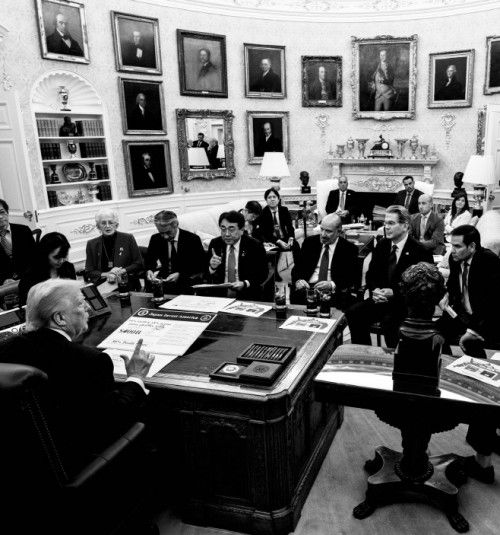
U.S. President Donald Trump speaks with Ryosei Akazawa, Japan’s economic and fiscal policy minister and lead negotiator, during a meeting at the White House on July 22. Also present were U.S. Secretary of State Marco Rubio (far right), Treasury Secretary Scott Besant, Commerce Secretary Howard Lutnick, and Japanese Ambassador to the U.S. Shigeo Yamada. / Source: Dan Scavino, White House Deputy Chief of Staff, via X (formerly Twitter) |
U.S. President Donald Trump has announced that tariff reductions will only be granted to countries that fully open their markets to American goods—citing Japan as the leading example.
In a Truth Social post on July 23, Trump wrote, “Tariffs will be lowered only for countries that agree to open their markets. Otherwise, they will face much higher tariffs.”
Referring to the newly concluded trade agreement with Japan, Trump said, “For the first time in history, the Japanese market is open to the U.S. American businesses will boom.”
In a separate post, Trump added, “If major countries agree to open their markets to America, I’m always willing to reduce tariffs. But without tariffs, it’s impossible to get countries to open up. That’s the power of tariffs.”
He reiterated, “Tariffs on the U.S. should always be zero.”
With reciprocal tariffs set to take effect on August 1, Trump has recently unveiled trade deals with Japan, the Philippines, and Indonesia—highlighting them as wins for U.S. market access.
Trump announced that Indonesia had agreed, for the first time, to fully open its market to the United States, calling it “big news” and saying American companies would benefit greatly.
On July 22, he also posted that “perhaps the most important part” of the Japan deal is Tokyo’s decision to open up its market in automobiles, trucks, rice, and some agricultural goods. “The U.S. will impose a 15% reciprocal tariff on Japan,” he wrote.
Japan’s policy shift came just two days after Prime Minister Shigeru Ishiba lost the July 20 upper house election, having initially rejected U.S. demands for full market access on American rice.
Trump further emphasized, “Remember, Japan is opening its market to America for the first time in history—cars, SUVs, trucks, everything, even agriculture and rice, which were previously untouchable.”
He added, “This open market in Japan may be just as valuable to us as the tariffs themselves. And we achieved it because of tariff leverage.”
According to Japan’s Nikkei newspaper, Tokyo plans to increase U.S. imports without altering its existing tariff structure. Japan will maintain the 770,000-ton quota for duty-free ‘minimum access rice,’ while expanding the share purchased from the U.S.
Bloomberg reported on the same day that Japan agreed to boost its U.S. rice imports by 75% and purchase an additional $8 billion in American goods, including agricultural products.
The Japanese government is also set to raise its annual defense-related purchases from U.S. firms from $14 billion to $17 billion.
Trump confirmed via Truth Social that “Japan has agreed to purchase billions of dollars’ worth of military and other equipment.”
ⓒ "젊은 파워, 모바일 넘버원 아시아투데이"
 이 기사의 카테고리는 언론사의 분류를 따릅니다.