 |
(Samsung Display) |
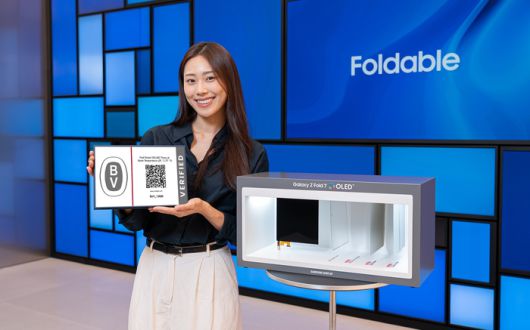
The new foldable organic light-emitting diode (OLED) display from Samsung Display Co., which is featured in the Galaxy Z Fold7, has once again proven its excellent durability by operating normally even after 500,000 folding tests.
Samsung Display, South Korean conglomerate Samsung Group’s display-making unit, announced on Tuesday that its new foldable panel passed the 500,000-fold durability test conducted by global certification agency Bureau Veritas.
“The test was conducted over 13 days at room temperature (25 degrees Celsius), and all the panels operated normally even after 500,000 repeated folds,” a Bureau Veritas official said.
The folding test evaluates durability by repeatedly folding and unfolding the screen.
Samsung Display raised the test standard to 500,000 times, 2.5 times more than the previous 200,000 times, to demonstrate its confidence in the panel’s robustness.
The 500,000 folds equate to over 10 years of usage for general users who fold and unfold their device around 100 times a day, and more than 6 years for heavy users who do so over 200 times a day.
Samsung Display explained that the result indicates that the durability of foldable panels is no longer a limiting factor for the lifespan of foldable smartphones. The company recently applied a new impact-resistant structure - developed based on the principles of bulletproof glass - to further enhance the durability of its foldable OLED.
Typical bulletproof glass uses a multi-layer structure composed of strengthened glass and special plastic films, which absorb the force of bullets through the elasticity of the glass surface, thus preventing penetration.
Inspired by this principle, Samsung Display increased the thickness of the Ultra-Thin Glass (UTG) that protects the outermost layer of the panel by 50 percent and replaced the adhesive between internal layers with a high-elasticity material whose resilience is more than four times stronger, thus improving shock absorption.
The company also adopted a flat-layer structure in the panel to better disperse external impacts while modifying the design to include a titanium plate, a component that supports the foldable panel.
This is the second use of a titanium plate in the Galaxy series, following the Galaxy Z Fold SE. Although titanium is difficult to process, it is thinner and stronger than other materials, allowing for a thinner panel with enhanced protection.
“As foldable OLED enters its seventh year of commercialization, 2025 marks another major leap forward in its durability and design,” Lee Ho-jung, executive vice president and head of product planning team for Samsung Display’s Small and Medium-sized Display division, said. “This new product will instill confidence in consumers regarding foldable panel durability and reaffirm our technological edge over competitors in the foldable space.”
 이 기사의 카테고리는 언론사의 분류를 따릅니다.


!["미혼 후회해" 병원에 주저앉아 오열...중국서 기이한 영상 유행 [지금이뉴스]](/_next/image?url=https%3A%2F%2Fthumb.zumst.com%2F256x144%2Fhttps%3A%2F%2Fstatic.news.zumst.com%2Fimages%2F4%2F2025%2F12%2F31%2F202512310930033397_t.jpg&w=384&q=100)