 |
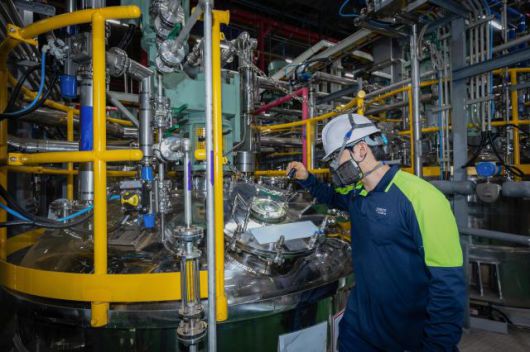
A POSCO Future M engineer checks manufacturing process at the precursor plant in Gwangyang, June 10, 2025. Courtesy of POSCO Future M |
About 40 major South Korean companies have closed or downsized their Chinese operations since 2017, according to the Korea Institute for International Economic Policy. The trend has expanded beyond retail to encompass key manufacturing sectors including automotive, steel and petrochemicals.
POSCO sold its stainless-steel subsidiary Zhangjiagang Pohang Stainless Steel to a Chinese steel company for about 400 billion won (US$290 million) earlier this month. The facility, established in 1997 to target the Chinese market, was once hailed as "China's POSCO" but has posted annual losses exceeding 100 billion won due to oversupply and price competition.
Hyundai Motor's Beijing Hyundai Motor Company joint venture has been shedding assets, selling its Chongqing factory last year, while currently pursuing the sale of its Changzhou plant.
Kumho Petrochemical also joined the exodus last year by divesting its entire stake in the SB latex business, a joint venture with a Chinese company.
Companies cite sluggish sales in China, intensified competition from local rivals, rising production costs and labor shortages as primary challenges. Beijing Hyundai's revenue plummeted 83.5 percent to 3.31 trillion won last year from 20.13 trillion won in 2016, while Hyundai's China sales dropped to 125,000 units with just 0.6 percent market share.
The business environment has deteriorated further since Donald Trump's second administration began, with strengthened sanctions against China creating additional uncertainty, with U.S. tariffs on Chinese products currently standing at 30 percent.
South Korea's overseas investment patterns reflect this dramatic shift. Chinese investment, which accounted for 39.1 percent of total foreign direct investment in 2005 at $2.92 billion, has collapsed to just 3 percent last year.
Meanwhile, U.S. investment has surged from $7.05 billion in 2015 to $22.29 billion last year, creating an 11.6-fold gap with Chinese investment. The divergence marks a striking reversal from 2010, when the two destinations received similar investment levels.
Trump's "Make America Great Again" agenda is expected to accelerate this trend, with POSCO and Hyundai Steel planning an integrated steel mill in Louisiana and LS Cable launching a $750 million subsea cable factory. Hyundai Motor Group also announced plans in March to invest an additional $21 billion in the U.S. over four years.
Kim Dong-young Business Reporter davekim0807@ajupress.com
- Copyright ⓒ [아주경제 ajunews.com] 무단전재 배포금지 -
 이 기사의 카테고리는 언론사의 분류를 따릅니다.


![크리스마스에 전해진 비보…故김영대 돌연 사망, '윤종신→정용화' 가요계 애도 물결 [엑's 이슈]](/_next/image?url=https%3A%2F%2Fthumb.zumst.com%2F256x144%2Fhttps%3A%2F%2Fstatic.news.zumst.com%2Fimages%2F108%2F2025%2F12%2F26%2Ff3d8a2f9e7734063b567b480ef23d115.jpg&w=384&q=100)


![가수 맹유나, 심장마비 돌연사…29세 교수 임용 앞두고 비보 [Oh!쎈 이슈]](/_next/image?url=https%3A%2F%2Fthumb.zumst.com%2F256x144%2Fhttps%3A%2F%2Fstatic.news.zumst.com%2Fimages%2F29%2F2025%2F12%2F26%2Feda5f3b658554aceb5ffad4928852296.jpg&w=384&q=100)