“Last June, all 23 European Space Agency member states unanimously approved collaboration with South Korea. The same applies to signing the Framework Agreement, which marks the first step in our cooperation.”
That was the message from Alexander Soucek, head of the External Relations Department at the European Space Agency (ESA), in an interview with Chosun Biz at ESA headquarters in Paris on July 7. ESA and South Korea’s newly launched Korea Aerospace Administration (KASA) are set to sign a framework agreement aimed at strengthening cooperation between the two agencies.
Since its establishment last year, KASA has identified ESA as a priority partner in expanding its global reach. After more than a year of steady outreach, the agency is now on the brink of formalizing its first major agreement with Europe’s top space agency.
That was the message from Alexander Soucek, head of the External Relations Department at the European Space Agency (ESA), in an interview with Chosun Biz at ESA headquarters in Paris on July 7. ESA and South Korea’s newly launched Korea Aerospace Administration (KASA) are set to sign a framework agreement aimed at strengthening cooperation between the two agencies.
Since its establishment last year, KASA has identified ESA as a priority partner in expanding its global reach. After more than a year of steady outreach, the agency is now on the brink of formalizing its first major agreement with Europe’s top space agency.
“Diversity is a key strength of South Korea’s space industry, which does not focus on just one area,” said Soucek, seated in ESA’s Eiffel Room with a view of the Eiffel Tower. “After the framework agreement is signed, the next important step will be to develop concrete joint programs between Korea and Europe.” He cited satellite navigation, fundamental science, astronomical exploration, and solar observation as promising areas for collaboration.
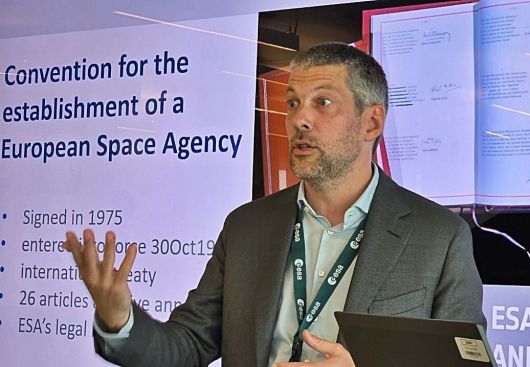 |
Alexander Soucek, head of the External Relations Department at the European Space Agency, speaks to South Korean reporters in Paris on July 7, 2025./Lee Jong-hyun |
ESA leads Europe’s space exploration, policy coordination, and research development, with an annual budget of €7.79 billion, or about 12.56 trillion won. It currently includes 23 European member states, with Canada participating as a cooperating partner. South Korea hopes to become an official ESA partner in the medium to long term.
As the Trump administration signals plans to scale back NASA’s role, deepening ties with ESA has emerged as a strategic priority for South Korea. According to Politico, the Trump administration is reportedly considering slashing NASA’s budget from $24.8 billion to $18.8 billion, with science programs expected to take the biggest hit. The report noted that around 2,000 senior NASA staff are preparing to resign.
A KASA official confirmed that the agency is preparing to sign the framework agreement with ESA. “This will open the way for South Korea to take part in major European-led programs, including Copernicus,” the official said, referring to the world’s largest Earth observation initiative, jointly operated by the European Commission and ESA.
Yet officials acknowledge that a long road lies ahead before South Korea can fully participate in ESA-led programs. “To directly join ESA programs or incorporate national projects into ESA’s system, a country must become an associate member,” Soucek explained. The framework agreement marks only the beginning of what could become a more formal and institutionalized relationship.
Among ESA’s 23 members, France remains the most active in space development, contributing €1.0749 billion this year—roughly 21.3 percent of ESA’s total budget. Germany and Italy follow, contributing 18.8 percent and 15.8 percent, respectively. ESA’s headquarters is located in Paris, in part because of France’s leading role.
Soucek emphasized that ESA’s strength lies not only in its largest contributors but also in the breadth of its partnerships. “ESA has signed over 600 agreements to date and establishes eight to 10 new agreements annually with partners worldwide,” he said. “ESA consists of 23 member states, but through these agreements, it collaborates globally.”
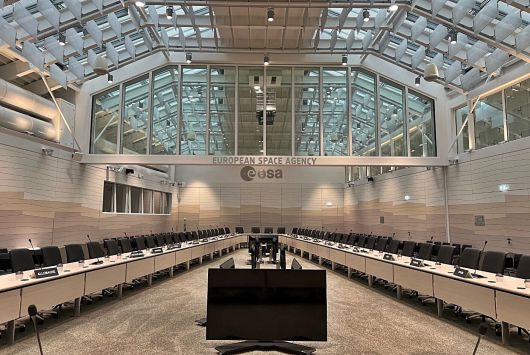 |
A view of the committee room where meetings of European Space Agency member states are held in Paris on July 7, 2025. The room’s walls are designed to resemble the surface of Mars, and the ceiling evokes the interior of a spacecraft./Lee Jong-hyun |
The ESA headquarters itself reflects this spirit of openness and collaboration. The second floor houses offices for staff from member countries and serves as the main venue for ESA committee meetings. The area includes three adjoining rooms that can be expanded into a single large space as needed.
“The corridor between the committee rooms and member offices is essentially a communication space where important decisions are made,” said an ESA official. “Enabling member states to communicate face-to-face is a key objective for ESA.”
(This article was produced with support from the Korea Press Foundation.)
[Lee Jong-hyun]
- Copyrights ⓒ 조선일보 & chosun.com, 무단 전재 및 재배포 금지 -
 이 기사의 카테고리는 언론사의 분류를 따릅니다.


![신정환, 뎅기열 16년만에 거짓말 들통 “친한 형의 아이디어”[순간포착]](/_next/image?url=https%3A%2F%2Fthumb.zumst.com%2F256x144%2Fhttps%3A%2F%2Fstatic.news.zumst.com%2Fimages%2F29%2F2026%2F01%2F15%2F82de70f3e2f442678901b88b9af85d91.png&w=384&q=100)