South Korea has set its minimum wage for 2026 at 10,320 won ($7.44) per hour, reflecting a 2.9% increase from the current rate. The decision, reached during the 12th plenary session of the Minimum Wage Commission on July 10, marks the first unanimous agreement among labor, business and public representatives in 17 years—raising speculation about the Lee Jae-myung administration’s future direction on labor policy.
The modest hike contrasts sharply with the more aggressive increases seen in previous administrations’ first years. Under President Roh Moo-hyun, the minimum wage rose by 10.3%; Moon Jae-in’s administration approved a 16.4% increase; and Yoon Suk-yeol’s first-year raise was 5%.
By contrast, the Lee administration’s tempered adjustment reflects a weakened economic climate and mounting pressure on small businesses, analysts say.
The modest hike contrasts sharply with the more aggressive increases seen in previous administrations’ first years. Under President Roh Moo-hyun, the minimum wage rose by 10.3%; Moon Jae-in’s administration approved a 16.4% increase; and Yoon Suk-yeol’s first-year raise was 5%.
By contrast, the Lee administration’s tempered adjustment reflects a weakened economic climate and mounting pressure on small businesses, analysts say.
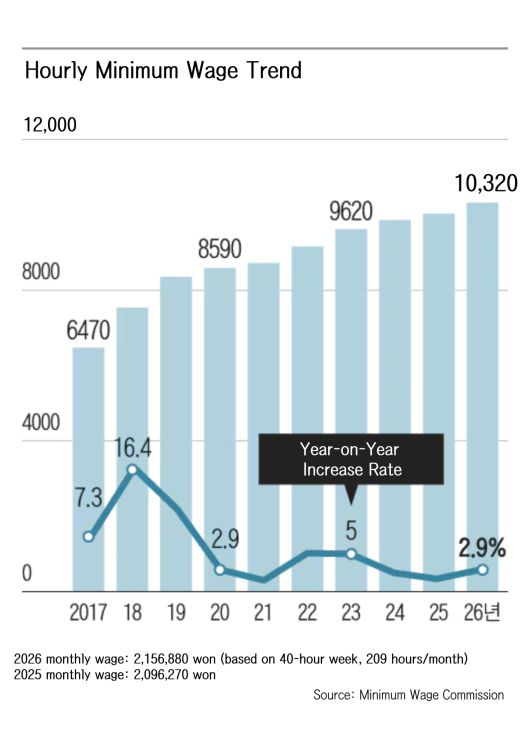 |
At the new hourly rate, a full-time worker on a 40-hour workweek would earn 2,156,880 won ($1,555) per month—60,610 won more than this year. Still, the rate falls well short of the demands from labor unions, which had called for a more aggressive push to address real wage stagnation and inflation.
Business groups, meanwhile, had pushed for a freeze or only a minimal increase, citing slowing consumer demand, higher interest rates, and soaring costs. In 2024 alone, a record 1,008,282 small businesses filed for closure, underscoring the fragility of South Korea’s post-pandemic recovery.
[Kim A-sa]
- Copyrights ⓒ 조선일보 & chosun.com, 무단 전재 및 재배포 금지 -
 이 기사의 카테고리는 언론사의 분류를 따릅니다.