South Korea has long associated its heaviest rainfall with the summer monsoon. But a new study of 45 years of weather data has confirmed what many residents have already begun to suspect: a new rainy season is emerging — in the fall.
Researchers at Ewha Womans University reported this week that cumulative rainfall between Sept. 10 and Oct. 10 has increased by 42 percent since 1998, compared to the period from 1979 to 1997. That early-autumn stretch now sees an average of 150 millimeters of rain, surpassing the totals from this year’s summer monsoon, which ended in early July with just 98 millimeters.
The shift, scientists say, is being driven by changes in typhoon activity caused by climate change. While summer typhoons have become less frequent, those forming and intensifying in the fall are increasingly steering more rain toward the Korean Peninsula.
Researchers at Ewha Womans University reported this week that cumulative rainfall between Sept. 10 and Oct. 10 has increased by 42 percent since 1998, compared to the period from 1979 to 1997. That early-autumn stretch now sees an average of 150 millimeters of rain, surpassing the totals from this year’s summer monsoon, which ended in early July with just 98 millimeters.
The shift, scientists say, is being driven by changes in typhoon activity caused by climate change. While summer typhoons have become less frequent, those forming and intensifying in the fall are increasingly steering more rain toward the Korean Peninsula.
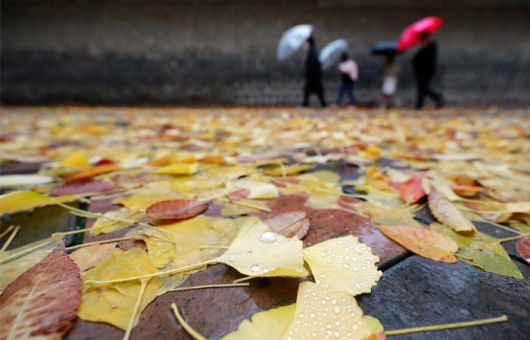 |
Autumn rain falls over fallen leaves on Jeongdong-gil, Seoul, in this file photo from Nov. 6, 2024./Chosun Ilbo DB |
Typically, strong high-pressure systems over the North Pacific prevent typhoons from reaching Korea during the summer. But as global temperatures rise, the retreat of those systems has been delayed, allowing autumn typhoons to move northward. At the same time, the storms are originating closer to Korea, as their formation zones shift westward in the Pacific.
Autumn typhoons, the researchers noted, are just as strong as those in the summer, fueled by warmer East Asian sea temperatures that produce greater moisture. The result is a notable rise in heavy rainfall during early fall, prompting scientists to formally recognize the period as an emerging seasonal phenomenon.
“The monthly window from Sept. 10 to Oct. 10, with more than 100 millimeters of rain, should be considered Korea’s autumn rainy season,” said Ho Chang-hoi, a professor at Ewha and lead author of the study.
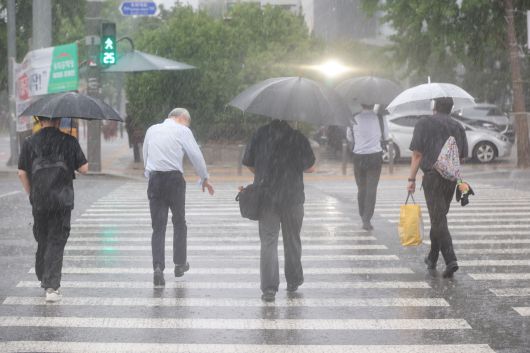 |
People walk in the rain near the National Assembly in Yeouido, Seoul, on July 8, 2025./Yonhap |
That trend is expected to continue. According to the Korea Meteorological Administration, between 1991 and 2020, an average of 5.6 typhoons formed in August and 5.1 in September. But from 2011 to 2020, the numbers reversed — 5.1 in August and 5.3 in September. Last year, eight typhoons formed in September alone.
With this year’s monsoon season cut short by the early expansion of the North Pacific high, researchers expect more rain to fall during the coming months.
“Climate change is reshaping seasonal rainfall patterns,” Professor Ho said. “We need to prepare not only for summer rain but also for the growing autumn rainy season.”
The findings were published July 4 in the journal Atmospheric Research under the title “Emergence of autumn rainy season in Korea due to tropical cyclone influence.”
[Park Sang-hyun]
- Copyrights ⓒ 조선일보 & chosun.com, 무단 전재 및 재배포 금지 -
 이 기사의 카테고리는 언론사의 분류를 따릅니다.