
K-pop powerhouse YG Entertainment is riding high following the comeback of its flagship group, Blackpink.
The beloved girl group returned to the stage after a three-year hiatus on July 5 with their “Deadline” world tour at the Goyang Sports Complex in Gyeonggi Province. The news sent YG’s stock soaring—shares closed at 86,000 won on July 8, more than double their value from the same period last year.
While Blackpink’s return is a welcome boost for YG, industry experts warn that the company’s heavy reliance on the group presents a structural vulnerability. In response, YG has recently pivoted toward building a more diversified portfolio of “super IPs.”
The beloved girl group returned to the stage after a three-year hiatus on July 5 with their “Deadline” world tour at the Goyang Sports Complex in Gyeonggi Province. The news sent YG’s stock soaring—shares closed at 86,000 won on July 8, more than double their value from the same period last year.
While Blackpink’s return is a welcome boost for YG, industry experts warn that the company’s heavy reliance on the group presents a structural vulnerability. In response, YG has recently pivoted toward building a more diversified portfolio of “super IPs.”
 |
Blackpink returned with their world tour “Deadline” on July 5, 2025. Pictured is member Rosé from the tour trailer./YG Entertainment |
Founded in February 1998, YG Entertainment initially focused on music publishing and artist management. The firm rose to prominence during the second-generation K-pop wave with acts like BigBang and 2NE1, and later went public on the Kosdaq in November 2011.
YG cemented its position in the 2010s by debuting new acts such as Winner, AKMU, and most notably, Blackpink. Touted as “monster rookies,” Blackpink broke into the charts within two weeks of debut and went on to set multiple streaming and YouTube records. Guinness World Records would later call them the “World’s Best Girl Group.”
As YG expanded, it branched into actor management through a Company-in-Company (CIC) model and launched YG Plus, a subsidiary focused on album distribution and merchandise leveraging artist IP. It also built affiliations with other labels, including The Black Label, founded by former YG producer Teddy, which manages rising acts like Meovv, izna, and the coed group Allday Project. YG currently owns a 14.55% stake in The Black Label.
YG’s largest shareholder remains founder and executive producer Yang Hyun-suk, with a 19.33% stake. Other significant investors include Naver (8.89%), the National Pension Service (5.23%), Yang Min-suk (3.47%), and Tencent (4.3%).
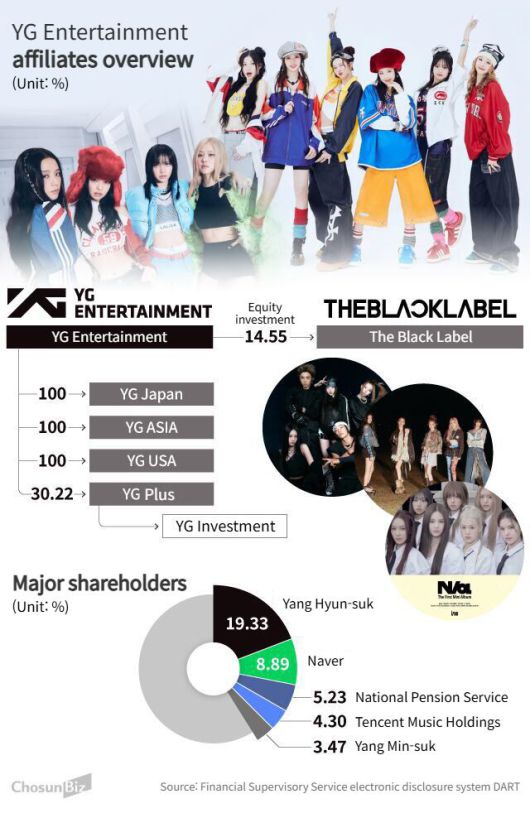 |
Graphics by Son Min-gyun |
The firm’s financial peak came in 2023, powered by Blackpink’s Born Pink world tour, which drew over 2.2 million fans across 65 shows. Revenue surged 45% to 569.2 billion won, while operating profit nearly doubled to 86.9 billion won.
But the group’s centrality to YG’s earnings has become a growing concern. While new girl group BabyMonster and boy group Treasure debuted or made comebacks in 2024, neither has yet matched Blackpink’s global commercial reach. With most idol groups lasting roughly seven years, analysts say YG’s concentration risk is unusually high. Industry estimates suggest Blackpink may have contributed over 80% of YG’s 2023 revenue.
After failing to secure full individual renewals and amid sparse team activities, YG’s top line dropped sharply in 2024. The company posted 364.9 billion won in revenue and an operating loss of 20.5 billion won—the firm’s first operating loss in two years.
Competitors are already hedging similar risks. Hybe reduced its dependence on BTS by acquiring Pledis Entertainment, home to Seventeen, in 2020. JYP, meanwhile, has built a more balanced portfolio with multiple global IPs including Twice and Stray Kids.
 |
Still from BabyMonster’s “Hot Sauce” music video./YG Entertainment |
In response to investor concern, YG has begun restructuring. “We realized it’s important to have multiple strong IPs,” said executive producer Yang Hyun-suk. “While BabyMonster promotes, we’ll keep other new artists active to expand our lineup.”
YG is also refocusing on its core music business. Following the departure of star producer Teddy, which raised questions about content output and quality, the company expanded its in-house production team from about 10 to 30. In early 2025, it announced it would exit actor management to prioritize its music division.
[Kim Jeong-eon]
- Copyrights ⓒ 조선일보 & chosun.com, 무단 전재 및 재배포 금지 -
 이 기사의 카테고리는 언론사의 분류를 따릅니다.


![가수 맹유나, 심장마비 돌연사…29세 교수 임용 앞두고 비보 [Oh!쎈 이슈]](/_next/image?url=https%3A%2F%2Fthumb.zumst.com%2F256x144%2Fhttps%3A%2F%2Fstatic.news.zumst.com%2Fimages%2F29%2F2025%2F12%2F26%2Feda5f3b658554aceb5ffad4928852296.jpg&w=384&q=100)


![크리스마스에 전해진 비보…故김영대 돌연 사망, '윤종신→정용화' 가요계 애도 물결 [엑's 이슈]](/_next/image?url=https%3A%2F%2Fthumb.zumst.com%2F256x144%2Fhttps%3A%2F%2Fstatic.news.zumst.com%2Fimages%2F108%2F2025%2F12%2F26%2Ff3d8a2f9e7734063b567b480ef23d115.jpg&w=384&q=100)