 |
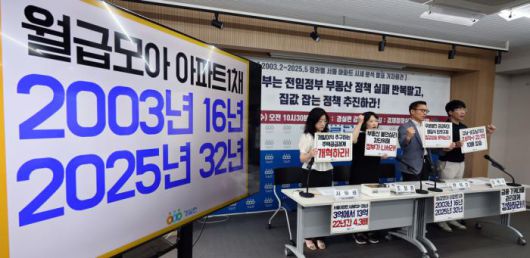
Attendees chant slogans during a press conference held by the Citizens' Coalition for Economic Justice on June 25, where the group released its analysis of Seoul apartment price trends by administration from February 2003 to May 2025. / Yonhap News |
With the recent surge in Seoul’s housing prices spreading from the Gangnam area to districts like Yongsan, Mapo, and Seongdong, the government has announced it will unveil new housing market stabilization measures in early July. Given the nature of the real estate market, early intervention is critical. What is needed now is a strong and comprehensive prescription that signals the government's firm commitment to curbing the rise.
According to the Ministry of Land, Infrastructure and Transport, the Ministry of Economy and Finance, and the Financial Services Commission on June 26, the government is expected to announce a package that includes expanding regulated zones and tightening lending restrictions next week. Originally, the government had planned to assess the impact of Phase 3 of the Debt Service Ratio (DSR) regulations, set to take effect next month, before deciding on additional measures. However, due to the sharp spike in housing prices, it has brought forward the policy announcement.
According to data released this week by the Korea Real Estate Board, apartment prices in Seoul rose by 0.43 percent compared to the previous week, marking the steepest weekly increase in six years and nine months. Those in Seongdong district rose by 0.99 percent, and Mapo by 0.98 percent, showing price spikes along the so-called "Hangang River Belt." In response, the government is considering expanding speculative and price-regulated zones, which currently only include Gangnam's three key districts and Yongsan district, at the upcoming Housing Policy Review Committee meeting next week. In price-regulated zones, heavier acquisition and capital gains taxes apply to those owning two or more homes. The government is also considering tightening the Loan-to-Value (LTV) and Debt-to-Income (DTI) ratios and possibly reinstating the ban on mortgage loans for houses priced over 1.5 billion won.
The current surge in Seoul’s housing prices is, in part, a result of the government and the Seoul city government loosening regulations. Housing prices began to climb after Seoul Mayor Oh Se-hoon removed Jamsil-dong of Songpa district and parts of Gangnam district, Samseong-dong, Daechi-dong, and Cheongdam-dong, from the list of land transaction permit zones this past February. President Lee Jae-myung also said during his presidential election campaign that he would not use taxes to control housing prices, which may have fueled speculative demand. Amid a steep drop in housing supply under the previous Yoon Suk-yeol administration, the market received only signals of deregulation.
To stabilize the real estate market, steady housing supply must be matched with demand-suppression measures, including loan, tax, and regulatory policies. Currently, excess liquidity remains in the market following government efforts to recover from the financial crisis and the coronavirus pandemic, and the government’s expansive “policy loans” have further fueled the price rise. Meanwhile, under the Yoon administration, the comprehensive real estate holding tax has been rendered ineffective, and Korea's effective property tax rate remains far below that of other developed countries.
In this urgent moment where prices are skyrocketing, what is needed is a multi-layered and integrated response. The government must expand regulations on loans and price-regulated zones while preparing phased tax policy solutions. The central and local governments must present both a firm will and substantive measures to curb rising housing prices, so that ordinary citizens do not feel left behind and speculative house-buying driven by excessive borrowing does not take hold.
※This article has undergone review by a professional translator after being translated by an AI translation tool.
▶ 매일 라이브 경향티비, 재밌고 효과빠른 시사 소화제!
▶ 주 3일 10분 뉴스 완전 정복! 내 메일함에 점선면 구독
©경향신문(www.khan.co.kr), 무단전재 및 재배포 금지
 이 기사의 카테고리는 언론사의 분류를 따릅니다.


![가수 맹유나, 심장마비 돌연사…29세 교수 임용 앞두고 비보 [Oh!쎈 이슈]](/_next/image?url=https%3A%2F%2Fthumb.zumst.com%2F256x144%2Fhttps%3A%2F%2Fstatic.news.zumst.com%2Fimages%2F29%2F2025%2F12%2F26%2Feda5f3b658554aceb5ffad4928852296.jpg&w=384&q=100)

![크리스마스에 전해진 비보…故김영대 돌연 사망, '윤종신→정용화' 가요계 애도 물결 [엑's 이슈]](/_next/image?url=https%3A%2F%2Fthumb.zumst.com%2F256x144%2Fhttps%3A%2F%2Fstatic.news.zumst.com%2Fimages%2F108%2F2025%2F12%2F26%2Ff3d8a2f9e7734063b567b480ef23d115.jpg&w=384&q=100)