 |
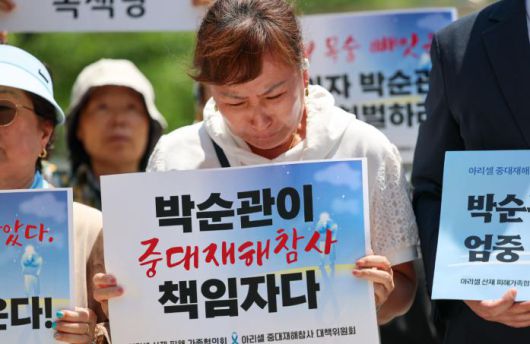
On June 23, one day before the first anniversary of the Aricell tragedy that claimed 23 lives, a bereaved family member sheds tears while attending a press conference in front of the Suwon District Court, calling for the punishment of Aricell CEO Park Soon-gwan. / Reporter Lee Jun-heon |
June 24 marks one year since the deadly battery explosion at lithium battery manufacturer Aricell that left 31 people dead or injured. Though the tragedy was the result of multiple overlapping labor issues, such as the outsourcing of risk, illegal dispatch practices, and poor health and safety management, there has been little progress in punishing those responsible or preventing similar incidents.
‘Outsourcing Risk to Migrant Workers’
As of June 23, reporting reveals that little has changed in terms of industrial safety management for migrant workers, even after the Aricell disaster. Of the 23 workers who died in the explosion, 18 were migrant workers, one from Laos and 17 from China. The “Aricell Disaster Countermeasure Committee” had called for stronger safety inspections for small and medium-sized workplaces, expanded labor inspections for employers of migrant workers, more effective industrial safety training, and the establishment of a dedicated department to address migrant worker safety, but most of these demands have not been implemented. In August of last year, the Ministry of Employment and Labor announced a plan to improve safety for foreign workers and small businesses. However, it focused only on expanding pre-arrival and post-arrival safety training, developing mobile apps and guidebooks for foreign workers, introducing health and safety interpreters, and appointing foreign worker safety leaders.
However, the death rate among migrant workers is on the rise. According to the ministry's report on industrial accident fatalities in the first quarter of this year, 20 of the 137 fatal accidents (14.6 percent) involved migrant workers, with seven (24.1 percent) occurring in manufacturing. In 2022, migrant workers accounted for 9.2 percent (85 out of 874) of all industrial fatalities in Korea. In 2023, they made up 10.4 percent (85 out of 812).
Kwon Mi-jung, a chairperson of the Kim Yong-gyun Foundation, said, “The agencies responsible for migrant worker management, including the Ministry of Justice, Ministry of Employment and Labor, Immigration Office, are fragmented. No one has a full picture of how these workers enter Korea, how they live, or how they die. A centralized agency is needed to oversee all aspects of migrant labor.”
‘No Government Action on Illegal Dispatch’
Illegal dispatch practices have also continued largely unchecked. Under Korea’s Dispatch Worker Protection Act, it is illegal to dispatch workers to core manufacturing operations. Nonetheless, Aricell received migrant workers from a company called Meisel (formerly Hanshin Dia). Meisel shared the same address as Aricell but was neither registered as an employment agency nor licensed to dispatch workers.
Meisel posted job ads on employment websites commonly used by Chinese migrant workers and provided those who responded with the location of Aricell’s commuter bus via phone calls, text messages, and KakaoTalk messenger. Once the workers arrived at the factory, Aricell staff guided them and assigned them to work. Meisel merely supplied labor to Aricell and did not handle any basic personnel management. This kind of illegal employment structure puts migrant workers at greater risk. The primary contractor shifts responsibility for safety management onto the dispatching firm, while the labor-supplying firm, serving only as a manpower broker, fails to provide any safety training.
After the explosion, the Ministry of Employment and Labor conducted inspections of small manufacturing businesses across Korea’s industrial complexes. In February, it confirmed that a first-tier subcontractor had illegally received 164 dispatched workers from a second-tier subcontractor (Meisel). However, Aricell’s parent company, S Connect, was not included in the findings. Choi Myung-seon of the Korean Confederation of Trade Unions (KCTU) criticized the government at a National Assembly forum, saying, “The government has conducted only superficial inspections and has no real countermeasures for illegal dispatch.”
‘Toothless Serious Accidents Punishment Act’
Aricell and S Connect CEO Park Soon-gwan was indicted and detained September of last year for violating the Serious Accidents Punishment Act, the first time a CEO was arrested under the law since its enactment. Prosecutors identified Park as the person with final responsibility for safety management, but in court, he denied the charge, claiming the real decision-maker was his son, Park Jung-eon, who serves as head of operations at Aricell. Park was released on bail in February. His son was indicted under the Occupational Safety and Health Act and for professional negligence resulting in death and injury, but not under the Serious Accidents Punishment Act.
Since the law’s implementation in 2022, cases resulting in actual prison terms for corporate leaders have been rare. As of the end of last year, there were 15 cases where a court ruling had been finalized. All 15 resulted in guilty verdicts, but only one involved a prison sentence of one year. The remaining 14 received suspended sentences of one to three years.
On the first anniversary of the tragedy, the bereaved families launched a petition demanding stronger punishment for CEO Park Soon-gwan and his son. On June 23, the Aricell Disaster Countermeasure Committee and the Aricell Industrial Accident Victims’ Family Council held a press conference outside the Suwon District Court and said that the petition would run through July 6. They plan to submit the signatures to the 14th Criminal Division of the Suwon District Court, which is overseeing the first trial.
※This article has undergone review by a professional translator after being translated by an AI translation tool.
▶ 매일 라이브 경향티비, 재밌고 효과빠른 시사 소화제!
▶ 주 3일 10분 뉴스 완전 정복! 내 메일함에 점선면 구독
©경향신문(www.khan.co.kr), 무단전재 및 재배포 금지
 이 기사의 카테고리는 언론사의 분류를 따릅니다.


!['선혜윤♥' 신동엽, 딸 명문대 보낸 비법?…자녀 사춘기→성교육 대공개 [엑's 이슈]](/_next/image?url=https%3A%2F%2Fthumb.zumst.com%2F256x144%2Fhttps%3A%2F%2Fstatic.news.zumst.com%2Fimages%2F108%2F2026%2F01%2F06%2F71029a0a06594ef49e25e65a4ab4cf2b.jpg&w=384&q=100)