Low-cost carrier (LCC) Air Premia, which operates long-haul routes to the Americas, said on June 23 that it will rename its “Premium Economy” class to “Wide Premium” beginning July 1. Positioned between business and economy, the seat class targets passengers seeking an upgraded experience without the high price tag of upper-tier cabins.
The airline noted that while many carriers offer premium economy options, the quality of service and seat pitch varies widely, often creating confusion among travelers. “We decided to rename the class to highlight our competitive edge—seat pitch ranging from 42 to 46 inches (106 to 110 centimeters), which is among the highest in the industry,” the company said.
Major South Korean carriers typically offer 29 to 32 inches between economy seats, making Air Premia’s offering roughly 1.5 times more spacious. This is the second time the company has rebranded the seat class. Originally launched as “Premia 42,” it was later renamed to align with the global “Premium Economy” standard before undergoing its latest rebranding to “Wide Premium.”
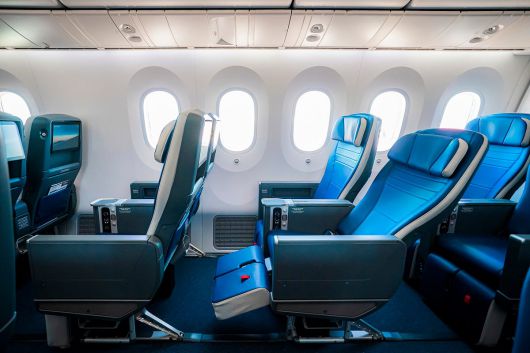 |
Air Premia's Wide Premium seats./Air Premia |
The airline noted that while many carriers offer premium economy options, the quality of service and seat pitch varies widely, often creating confusion among travelers. “We decided to rename the class to highlight our competitive edge—seat pitch ranging from 42 to 46 inches (106 to 110 centimeters), which is among the highest in the industry,” the company said.
Major South Korean carriers typically offer 29 to 32 inches between economy seats, making Air Premia’s offering roughly 1.5 times more spacious. This is the second time the company has rebranded the seat class. Originally launched as “Premia 42,” it was later renamed to align with the global “Premium Economy” standard before undergoing its latest rebranding to “Wide Premium.”
The move underscores the growing competition in the premium economy segment across the aviation industry. Jeju Air, South Korea’s largest LCC, operates a comparable product under the name “Business Lite,” while Korean Air is preparing to phase out first-class cabins on select routes and introduce premium economy seating later this year. The strategy aims to capture demand from mid-tier travelers—passengers who are willing to pay more than standard economy but less than the cost of business or first class, which often fly with empty seats. Asiana Airlines has also entered the space, offering its upgraded “Economy Smartium” seats for an additional fee.
The rising appeal of premium economy is largely driven by cost-effectiveness. Fares are typically about 1.5 times higher than standard economy—around 1.5 million won for a 1 million won economy ticket. The roomier seating is particularly appealing on long-haul routes. Additional perks such as dedicated check-in counters and priority boarding enhance the value proposition. With business class seats usually priced at two to four times the economy fare, and first class at up to six times more, many passengers view premium economy as a worthwhile and more affordable upgrade.
[Park Soon-chan]
- Copyrights ⓒ 조선일보 & chosun.com, 무단 전재 및 재배포 금지 -
 이 기사의 카테고리는 언론사의 분류를 따릅니다.


![성매매 요구 거절에 격분…종로 여관에 불 질러 7명 목숨 앗아갔다[그해 오늘]](/_next/image?url=https%3A%2F%2Fthumb.zumst.com%2F256x144%2Fhttps%3A%2F%2Fstatic.news.zumst.com%2Fimages%2F24%2F2026%2F01%2F21%2Fa150eeb1bf52474a9ab984919d90c1ca.jpg&w=384&q=100)