President Lee Jae-myung has decided not to attend this week’s NATO summit in the Netherlands, a late-stage decision that raises fresh questions about the foreign policy direction of his nascent administration. On June 23, the presidential office announced that Wi Sung-lac, Lee’s national security adviser, would attend in his place.
The move is unusual: it is rare for a sitting president to delegate attendance at a major multilateral gathering to a senior aide, particularly one of Wi’s rank. Observers say the appointment of Wi—currently the most senior figure in South Korea’s foreign and security establishment—signals that the president is acutely aware of both the domestic and international scrutiny his absence may provoke.
Lee had initially weighed attending the summit, partly in the hopes of arranging a bilateral meeting with U.S. President Donald Trump. A similar attempt during the recent G7 summit in Canada fell through when Trump returned to Washington early amid escalating tensions in the Middle East.
The move is unusual: it is rare for a sitting president to delegate attendance at a major multilateral gathering to a senior aide, particularly one of Wi’s rank. Observers say the appointment of Wi—currently the most senior figure in South Korea’s foreign and security establishment—signals that the president is acutely aware of both the domestic and international scrutiny his absence may provoke.
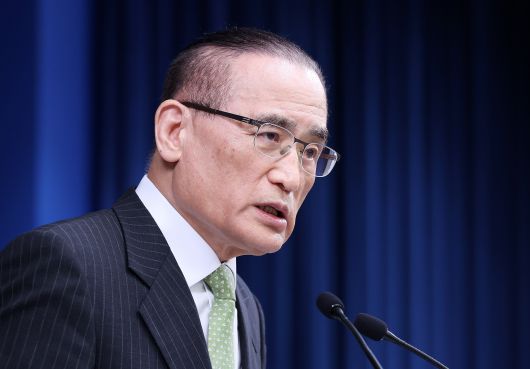 |
National Security Adviser Wi Sung-lac gives a briefing on G7 summit diplomacy at the presidential office in Yongsan, Seoul, on June 15, 2025./News1 |
Lee had initially weighed attending the summit, partly in the hopes of arranging a bilateral meeting with U.S. President Donald Trump. A similar attempt during the recent G7 summit in Canada fell through when Trump returned to Washington early amid escalating tensions in the Middle East.
Without a firm commitment from Washington for a one-on-one meeting in the Netherlands, Lee ultimately chose to stay in Seoul. “Had the summit with President Trump been confirmed, we would have gone despite the situation in the Middle East,” a presidential official said. “But given the uncertainty, it was judged more beneficial to focus on economic issues and cabinet appointments at home.”
Still, analysts warned that Lee’s absence could send the wrong message to Western allies. The NATO summit is expected to focus heavily on joint responses to security threats posed by Russia, China, and North Korea. Lee’s decision to sit out the gathering could be perceived as a “conspicuous absence,” some experts said, particularly as his predecessor attended the last three summits in a row—part of a broader shift toward tighter engagement with the transatlantic alliance.
 |
President Lee Jae-myung attends an expanded session of the G7 summit over a working lunch in Kananaskis, Alberta, Canada, on June 17, 2025./Presidential Office |
Presidential officials downplayed the implications. “No South Korean president attended NATO before the Yoon administration,” one official noted, arguing the move was not without precedent. But critics countered that with South Korea now a regular participant in NATO summits, skipping one without a clear explanation risks appearing inconsistent.
Complicating matters further is one of the summit’s core agenda items: the U.S.-led push for NATO members to significantly raise their defense spending. Trump has repeatedly called on allies to boost military budgets to 5 percent of GDP. NATO Secretary General Mark Rutte has proposed a model allocating 3.5 percent to direct military expenditure and another 1.5 percent to broader security initiatives—a framework with potential implications for South Korea’s own defense cost-sharing negotiations with Washington.
Against this backdrop, some analysts questioned whether Lee’s absence undermines his administration’s repeated emphasis on the strength of the U.S.-Korea alliance. Even without a formal summit with Trump, they said, attending the NATO meeting could have reinforced Seoul’s commitment to the Western security bloc.
Uncertainty over scheduling a face-to-face with Trump is not unique to South Korea. “Even other heads of state rarely get guarantees from Trump,” said one official. Still, in Seoul, the decision to forgo a key multilateral stage in pursuit of a meeting that never materialized has led some to question whether Lee’s “pragmatic diplomacy” is veering into reactive territory.
“There are competing voices within the Lee government’s foreign policy team,” one political insider noted. “How they handle future situations like this may depend less on strategy than on which faction ends up louder.”
[Park Sang-ki]
- Copyrights ⓒ 조선일보 & chosun.com, 무단 전재 및 재배포 금지 -
 이 기사의 카테고리는 언론사의 분류를 따릅니다.


![가수 맹유나, 심장마비 돌연사…29세 교수 임용 앞두고 비보 [Oh!쎈 이슈]](/_next/image?url=https%3A%2F%2Fthumb.zumst.com%2F256x144%2Fhttps%3A%2F%2Fstatic.news.zumst.com%2Fimages%2F29%2F2025%2F12%2F26%2Feda5f3b658554aceb5ffad4928852296.jpg&w=384&q=100)

![크리스마스에 전해진 비보…故김영대 돌연 사망, '윤종신→정용화' 가요계 애도 물결 [엑's 이슈]](/_next/image?url=https%3A%2F%2Fthumb.zumst.com%2F256x144%2Fhttps%3A%2F%2Fstatic.news.zumst.com%2Fimages%2F108%2F2025%2F12%2F26%2Ff3d8a2f9e7734063b567b480ef23d115.jpg&w=384&q=100)