South Korea’s construction industry is on edge as geopolitical tensions in the Middle East threaten to spill over into global energy markets—and into their bottom lines.
Iran’s recent parliamentary resolution to block the Strait of Hormuz—one of the world’s most critical energy chokepoints—has sparked concerns that infrastructure projects across the region could face delays, disruption, or even cancellation. The narrow waterway handles up to 30% of the world’s oil and liquefied natural gas shipments, and any interruption could send energy and raw material costs soaring.
While the blockade has not been implemented—it would require final approval from Iran’s Supreme Leader, Ayatollah Ali Khamenei—the warning alone has rattled South Korean firms. The escalation followed U.S. airstrikes on three Iranian nuclear facilities on June 21, which prompted the Iranian parliament to authorize the strait’s closure.
Iran’s recent parliamentary resolution to block the Strait of Hormuz—one of the world’s most critical energy chokepoints—has sparked concerns that infrastructure projects across the region could face delays, disruption, or even cancellation. The narrow waterway handles up to 30% of the world’s oil and liquefied natural gas shipments, and any interruption could send energy and raw material costs soaring.
While the blockade has not been implemented—it would require final approval from Iran’s Supreme Leader, Ayatollah Ali Khamenei—the warning alone has rattled South Korean firms. The escalation followed U.S. airstrikes on three Iranian nuclear facilities on June 21, which prompted the Iranian parliament to authorize the strait’s closure.
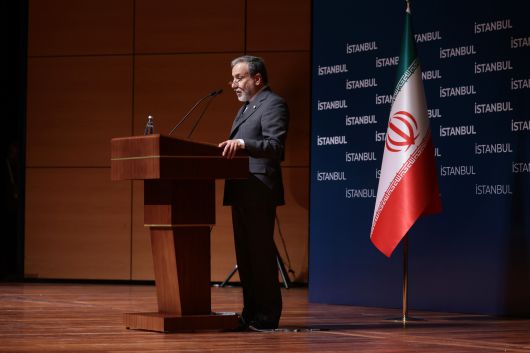 |
Iranian Foreign Minister Abbas Araghchi speaks during a press conference in Istanbul, Turkey, on June 22, 2025. A day earlier, U.S. President Donald Trump announced that American forces had struck three of Iran’s nuclear sites—Natanz, Isfahan and Fordow—amid escalating clashes between Israel and Iran./EPA-Yonhap |
According to the International Contractors Association of Korea, South Korean builders have secured $5.64 billion worth of construction orders in the Middle East so far this year, accounting for nearly 49% of the country’s total overseas orders. With nearly half of their international revenue tied to the region, firms face mounting uncertainty.
Among those with major exposure is Hyundai Engineering & Construction, which is leading a $389 million transmission line project in Saudi Arabia linking solar power facilities in Medina and Jeddah. The project began in January and is scheduled for completion in late 2027.
In Iraq, Hanwha E&C is spearheading the Bismayah New City development near Baghdad—a massive urban project that includes more than 100,000 housing units. About 30,000 homes have been completed, with additional phases awaiting approval from Iraq’s Council of Ministers.
Samsung C&T is also active in the region, working with local partner Trojan General Contracting to build a 1,000-megawatt gas-fired power plant in the Al Dhafra region of the United Arab Emirates.
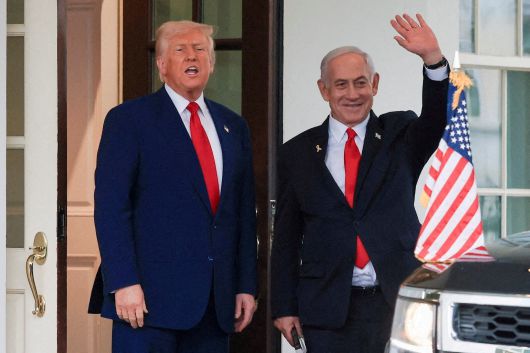 |
U.S. President Donald Trump speaks as Israeli Prime Minister Benjamin Netanyahu waves following a meeting in the White House, in Washington, on April 7, 2025./Reuters-Yonhap |
Should the Strait of Hormuz be blocked, or tensions escalate further, access to key construction materials—particularly oil-related products—could be severely disrupted. Analysts warn that a sustained spike in energy prices and heightened currency volatility could squeeze margins and delay procurement.
“Most of the crude oil imported into South Korea is Dubai crude,” said Lee Eun-hyung, a researcher at the Korea Research Institute for Construction Policy. “If shipments are cut off or delayed, it could drive up prices and have a ripple effect across not just construction, but the entire industrial economy.”
Yoon Sung-wook, a political science professor at Chungbuk National University, agreed. “Roughly 70% to 80% of Korea’s oil imports are Dubai crude,” he said. “A price shock would be difficult to absorb across industries.”
Construction executives are particularly concerned about logistical choke points. “If the blockade becomes a reality, we could be looking at worst-case scenarios,” said Kim Hyeong-mi, head of the Middle East-Europe division at the International Contractors Association of Korea. “Freight delays could bring multiple regional projects to a standstill.”
For now, most sites are continuing operations, but firms are on high alert. “We haven’t seen direct disruptions yet in countries neighboring Iran,” said one company official, “but we’re monitoring input costs, worker safety, and sourcing—especially where oil-linked materials are involved.”
Another executive noted, “No immediate red flags, but we’re watching closely to see how far this situation could escalate.”
[Jung Hae-yong]
- Copyrights ⓒ 조선일보 & chosun.com, 무단 전재 및 재배포 금지 -
 이 기사의 카테고리는 언론사의 분류를 따릅니다.