 |
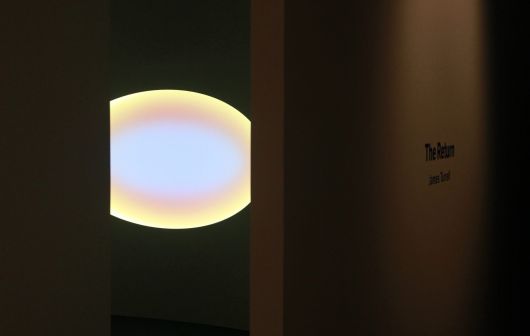
The entrance of Pace Gallery in Hannam-dong, Seoul, is seen ahead of the opening of James Turrell’s solo exhibition on June 14, 2025. A glimpse of Longing, Wild Elliptical Curved Glass (2021) is visible./Park Su-hyeon |
By any account, the history of art is suffused with the pursuit of light. Whether as divine emanation, natural phenomenon, or psychological metaphor, light has long served as both subject and medium—from the gilded glow of Byzantine icons to the atmospheric experiments of Turner and the transcendental hues of Rothko. Yet few artists have been as wholly preoccupied with light itself—its physicality, its metaphysics, its power to disorient and awaken—as James Turrell. For more than sixty years, Turrell has not painted light, nor depicted it; he has sought to use light as a material in its own right.
“Art has always dealt with things that lie beyond the way we normally think,” Turrell said during a press preview at Pace Gallery in Seoul on June 11. “It confronts us with what we haven’t yet imagined. The history of art is full of artists who depicted light—and those depictions have meant a great deal to us. But I wanted to use light itself, not just show it. And to do that, I had to create the instrument that could shape it. You can’t carve light like wood or stone. You can’t weld it. You have to produce it.”
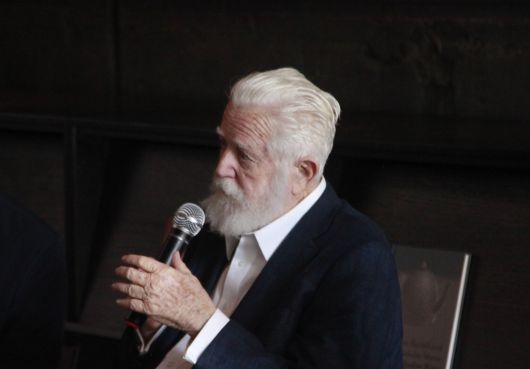 |
James Turrell speaks to reporters during a press preview at Pace Gallery in Seoul on June 11, 2025./Park Su-hyeon |
It is a characteristically simple yet radical proposition—and one that Turrell has realized through decades of refined experimentation. Emerging in the late 1960s among a circle of Southern California artists later associated with the Light and Space movement, Turrell turned away from conventional image-making and toward a phenomenological approach to experience. His early light projections—such as Afrum (Proto) (1966)—used high-intensity tungsten beams to create immaterial forms that appeared, paradoxically, as solid volumes. Other works, including the Mendota Stoppages (1969–74), transformed abandoned rooms into camerae obscurae that manipulated daylight into calibrated shafts and spectral geometries.
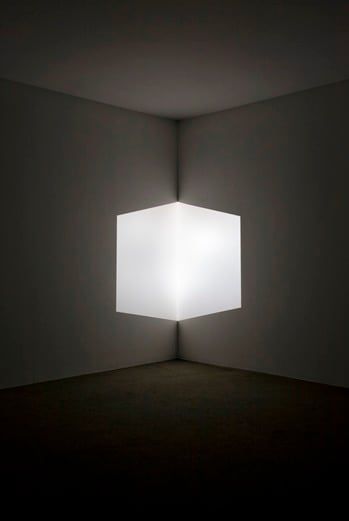 |
Afrum (White) (1966) by James Turrell./Los Angeles County Museum of Art |
Born in Los Angeles in 1943 to a Quaker mother and an aeronautical engineer father, Turrell’s lifelong obsession with the sky began in flight. He earned his pilot’s license at 16 and later studied perceptual psychology at Pomona College, followed by graduate studies in art. His Quaker upbringing—steeped in silence, introspection, and the idea of “inner light”—proved equally foundational.
This tension between the physical and the transcendent—between scientific inquiry and spiritual resonance—animates all of Turrell’s work. He speaks of light not only as something seen but as something felt. “Light has a very physical presence,” he said. “Ultraviolet light, through the skin, helps the body make vitamin D. Without it, serotonin levels drop, and that can lead to depression. So in a very real sense, we are light-eaters. It’s part of our daily diet.”
But there is also, he insists, a spiritual dimension to light—one that enters even our dreams. “Think of the lucid dream. Where does the light in that dream come from? Sometimes, with our eyes closed, we see with even greater clarity. That’s an extraordinary thing.”
This interplay of perception, psychology, and metaphysics reaches its apotheosis in Roden Crater, Turrell’s monumental life project in the Arizona desert. Since the 1970s, he has been transforming an extinct volcanic cinder cone into a naked-eye observatory—an artwork built not to be seen but to see through. Inside, chambers and tunnels align with celestial events, harnessing sunlight and starlight with astronomical precision.
“I promised I’d open Roden Crater in the year 2000,” Turrell said with a smile. “And I’m sticking to it. The problem is, in a drawing, a tunnel looks quite manageable. Then you realize it’s going to be 900 feet long, 14 feet in diameter, and cost millions to build. So yes, it’s taken longer than I thought. But like some people finishing their PhDs, I’d like to complete it before I pass. Like my wife says, I’m very trying.”
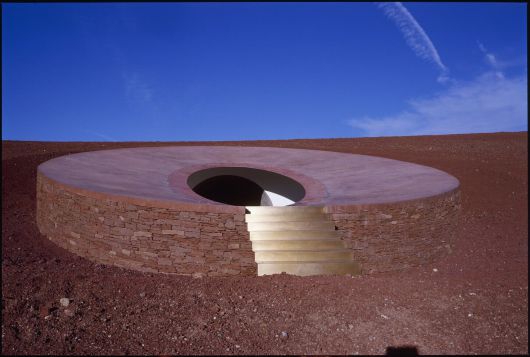 |
East Portal of Roden Crater./Skystone Foundation-James Turrell |
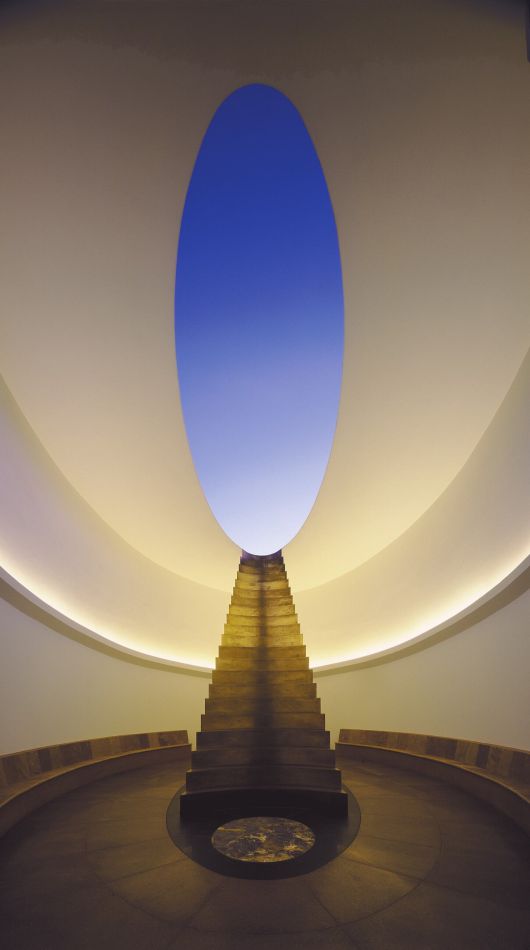 |
East Portal of Roden Crater./Skystone Foundation-James Turrell |
While Roden Crater remains unfinished, Turrell’s new exhibition, The Return, opening this weekend at Pace Gallery in Seoul, offers a rare opportunity to experience his immersive work in Korea for the first time since 2008. Spanning all three floors of the gallery, the exhibition includes recent light installations, prints, and photographs that document both the construction of the crater and the artist’s evolving optical vocabulary. Turrell arrived in Seoul three days prior to the preview, in his usual attire of jeans and a T-shirt, meticulously overseeing final adjustments—including a last-minute repainting of walls. At 82, he moves deliberately but speaks with the undimmed curiosity of someone still captivated by the mysteries of perception.
“I think some people feel confused or even dizzy in my installations,” he said. “It’s because we’re used to structuring our reality with horizons. Take away the horizon, and it’s like being a pilot in a fog, or a skier in white-out conditions. Or a diver in the ocean—only the bubbles tell you which way is up.”
Turrell calls this the “landscape without horizon”—a perceptual state that, he argues, we are already entering in the digital age. “At first, it can be disorienting. But like a new pilot doing aerobatics, after a while, you come to enjoy it. You even seek it. I want to explore that universe with the work I do.”
Toward the end of the preview, Turrell paused to reflect with characteristic humility. “In the end, I’m just an artist trying to give you a piece of light. Not every piece succeeds. But you have a taste of how I’ve gone through this and what I like to do, and my love for light as well as art.” He shrugged. “Art’s not the biggest thing in the world. But this is my job. I’m trying to do my job.”
[Park Su-hyeon]
- Copyrights ⓒ 조선일보 & chosun.com, 무단 전재 및 재배포 금지 -
 이 기사의 카테고리는 언론사의 분류를 따릅니다.


![가수 맹유나, 심장마비 돌연사…29세 교수 임용 앞두고 비보 [Oh!쎈 이슈]](/_next/image?url=https%3A%2F%2Fthumb.zumst.com%2F256x144%2Fhttps%3A%2F%2Fstatic.news.zumst.com%2Fimages%2F29%2F2025%2F12%2F26%2Feda5f3b658554aceb5ffad4928852296.jpg&w=384&q=100)

![크리스마스에 전해진 비보…故김영대 돌연 사망, '윤종신→정용화' 가요계 애도 물결 [엑's 이슈]](/_next/image?url=https%3A%2F%2Fthumb.zumst.com%2F256x144%2Fhttps%3A%2F%2Fstatic.news.zumst.com%2Fimages%2F108%2F2025%2F12%2F26%2Ff3d8a2f9e7734063b567b480ef23d115.jpg&w=384&q=100)