
 |
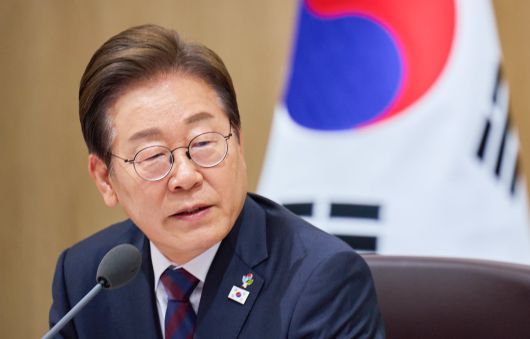
President Lee Jae-myung delivers opening remarks during a Cabinet meeting at the presidential office building in Seoul on June 10. /Presidential office |
President Lee Jae-myung is reportedly making a last-minute decision on whether to attend the NATO summit in The Hague, Netherlands on June 24–25. While NATO officially invited President Lee, many aides believe attending the summit immediately after the G7 meeting from June 15 to 17 would be too demanding for the newly formed government. However, experts say that despite domestic challenges like cabinet formation, it is “reasonable” for the president to accept the invitation, given the six-month gap in high-level diplomacy. They warn that if South Korea skips the summit this year, it would be seen as a “conspicuous absence,” creating the impression that the country’s foreign policy is shifting.
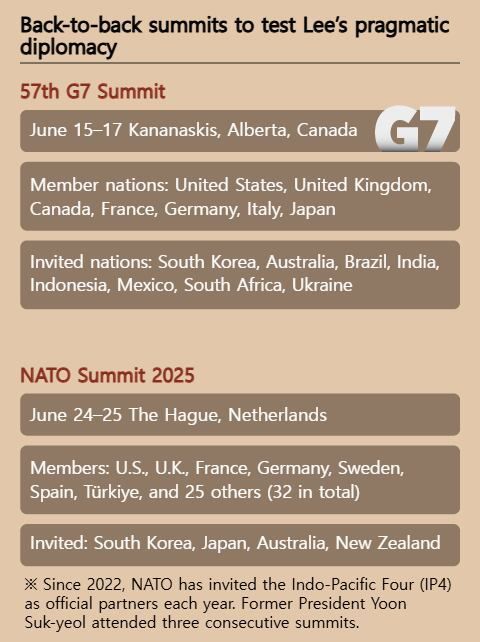 |
Since Russia’s invasion of Ukraine in 2022, NATO has invited South Korea, Japan, Australia, and New Zealand—known as the Indo-Pacific Four (IP4)—to strengthen security cooperation in the region. Former President Yoon Suk-yeol attended the summit for three consecutive years starting in 2022. President Lee has now received his fourth invitation as a leader of the IP4 countries.
Analysts say the decision on attending the NATO summit will be a more important test of President Lee’s ‘pragmatic diplomacy’ than the upcoming G7 meeting. Lee Hyun-ju, former ambassador for international security affairs at the Ministry of Foreign Affairs, said the invitation reflects South Korea’s growing status and global expectations. “China and Russia may see attendance as routine, but skipping the summit—whatever the reason—could be seen as a conspicuous absence,” he said.
Seoul National University professor Park Jong-hee told the Chosun Ilbo that concerns over NATO’s ideological stance have eased. While Ukraine’s NATO membership sparked intense debate at last year’s summit, this year’s agenda does not include such contentious issues.
Some ruling party members reportedly express reluctance, saying, “Attending NATO just continues the previous Yoon government’s stance.” However, experts point out that South Korea’s cooperation with NATO began under the Moon Jae-in government and has been bipartisan. In 2017, Moon met then-NATO Secretary General Jens Stoltenberg at Cheong Wa Dae or Blue House, expressing hope for stronger military ties. The Moon administration also initiated South Korea’s accession to NATO’s Cooperative Cyber Defence Centre of Excellence in 2019 and decided to participate in NATO’s annual cyber defense exercise, Locked Shields, in 2021.
Professor In Nam-sik of the Korea National Diplomatic Academy emphasized that diplomacy relies on predictability. “Unless there is a major policy shift, consistency is essential. If global partners like NATO keep guessing South Korea’s next move, it harms our national interests,” he said. He also suggested that President Lee’s attendance could highlight South Korea’s experience in restoring constitutional order during times of crisis, adding value beyond simple participation.
[Roh Suk-jo]
- Copyrights ⓒ 조선일보 & chosun.com, 무단 전재 및 재배포 금지 -
 이 기사의 카테고리는 언론사의 분류를 따릅니다.