 |
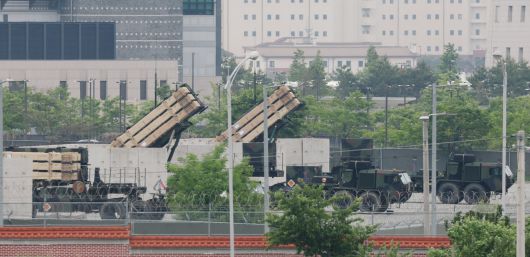
A Patriot (PAC-3) missile system is seen deployed at Camp Humphreys, a U.S. military base in Paengseong-eup, Pyeongtaek, Gyeonggi Province, on May 23, 2025. The Wall Street Journal reported on May 22 that the Trump administration is considering withdrawing about 4,500 U.S. troops from South Korea and relocating them to other Indo-Pacific bases such as Guam. /News1 |
The Trump administration considered withdrawing 4,500 of the 28,500 U.S. troops stationed in South Korea, according to a report by the Wall Street Journal that cited U.S. defense officials. The plan reportedly involved relocating those troops to other parts of the Indo-Pacific region, such as Guam. The U.S. Department of Defense, however, denied the report, saying it was “not true.”
Still, the idea of adjusting the American military presence in S. Korea did not originate with Trump. Long before his presidency, Washington had laid out a broader vision to expand the role and operational range of U.S. Forces Korea (USFK). This strategy—often referred to as “strategic flexibility”—has been applied across all overseas U.S. forces.
It reflects a shift in focus: while the United States concentrates on countering China, allied nations are expected to take more responsibility for conventional defense, particularly against non-nuclear threats.
That shift became even more explicit last year, when the U.S. undersecretary of defense for policy said the Pentagon was reorganizing U.S. forces in Korea to focus more on China, while encouraging S. Korea to take on a larger share of the burden in deterring North Korea’s conventional military threats. In that light, the reported consideration of withdrawing 4,500 troops was not entirely unexpected.
Notably, the number aligns with the size of a Stryker Brigade Combat Team, which the United States has been rotating through S. Korea every nine months. The move now appears to signal a possible end to this rotational deployment—a development that American defense analysts have repeatedly flagged as a likely scenario.
The implications for regional security, however, may be less dramatic than they seem. In terms of conventional ground firepower, U.S. forces in Korea already play a relatively limited role.
If the 4,500 troops were pulled out, only an artillery brigade would remain among the U.S. combat units on the peninsula.
This downsizing trend has been underway for years, as the U.S. has gradually reduced its conventional presence while South Korea has significantly strengthened its own military capabilities.
Today, S. Korea’s conventional forces—across its army, navy, and air force—overwhelm North Korea’s. Meanwhile, the U.S. Air Force’s role in Korea, particularly in countering China, is expected to grow rather than shrink.
As long as Washington continues to provide support for nuclear deterrence and maintains surveillance and reconnaissance over North Korea, many defense analysts believe that the overall deterrent posture will remain stable.
What raises concern is not the troop number itself, but how it could be used politically.
A U.S. defense official told the Journal that the drawdown idea was being considered in the context of Trump’s approach to North Korea. During his presidency, Trump suspended joint U.S.-S. Korea military exercises—a cornerstone of the alliance—as part of his summit diplomacy with Kim Jong-un.
U.S. Forces Korea stands as a symbolic and strategic pillar of S. Korea’s national security. While some adjustments in troop levels may reflect broader U.S. military strategy, leveraging those forces as a bargaining chip for political theater—particularly to placate Kim—would be an entirely different matter. Given Trump’s unpredictability, S. Korea may have little choice but to prepare for every contingency.
[The Chosunilbo]
- Copyrights ⓒ 조선일보 & chosun.com, 무단 전재 및 재배포 금지 -
 이 기사의 카테고리는 언론사의 분류를 따릅니다.


!['200억 탈세 의혹' 차은우, 사상 최대 규모…母 회사·군대 도피 의혹 입장은 [종합]](/_next/image?url=https%3A%2F%2Fthumb.zumst.com%2F256x144%2Fhttps%3A%2F%2Fstatic.news.zumst.com%2Fimages%2F108%2F2026%2F01%2F22%2F032c6b87464546feac25f36f13570878.jpg&w=384&q=100)

!["내 여친 성폭행 해 줘" 유명 쇼핑몰 사장의 두 얼굴 [그해 오늘]](/_next/image?url=https%3A%2F%2Fthumb.zumst.com%2F256x144%2Fhttps%3A%2F%2Fstatic.news.zumst.com%2Fimages%2F24%2F2026%2F01%2F23%2F5592c33256624fbea6ee6370cd5b1fee.jpg&w=384&q=100)