The next-generation wireless standard, Wi-Fi 7, is entering full-scale commercialization this year in South Korea. While much of the technological groundwork was completed by last year, adoption in consumer environments—such as homes and smartphones—had lagged behind. That is now changing, with routers, laptops, and smartphones supporting Wi-Fi 7 hitting the market, making the technology increasingly accessible to everyday users.
According to the Ministry of Science and ICT, Wi-Fi 7 delivers maximum transmission speeds of up to 46Gbps—approximately 4.8 times faster than the 9.6Gbps offered by previous Wi-Fi standards. That means a video download that once took one minute could now be completed in roughly 12 to 13 seconds. With compatible devices becoming more widely available and public infrastructure planning underway, experts forecast a rapid transition to Wi-Fi 7 over the next two to three years.
Wi-Fi 7 offers significant improvements in both speed and stability compared to its predecessor, Wi-Fi 6E. Industry experts liken the upgrade to opening a new expressway and widening existing lanes on the data highway.
According to the Ministry of Science and ICT, Wi-Fi 7 delivers maximum transmission speeds of up to 46Gbps—approximately 4.8 times faster than the 9.6Gbps offered by previous Wi-Fi standards. That means a video download that once took one minute could now be completed in roughly 12 to 13 seconds. With compatible devices becoming more widely available and public infrastructure planning underway, experts forecast a rapid transition to Wi-Fi 7 over the next two to three years.
 |
 |
Graphics by Kim Sung-kyu |
Wi-Fi 7 offers significant improvements in both speed and stability compared to its predecessor, Wi-Fi 6E. Industry experts liken the upgrade to opening a new expressway and widening existing lanes on the data highway.
Most notably, Wi-Fi 7 expands the frequency spectrum used for data transmission. In addition to the existing 2.4GHz and 5GHz bands, the new standard incorporates the 6GHz band—akin to adding an express lane to a previously congested road system. If earlier frequencies were like unpaved or narrow roads, the 6GHz band functions as a dedicated high-speed route for data.
While higher frequencies enable faster data speeds, they are also more prone to interference from physical obstacles. To address this, Wi-Fi 7 integrates a technology known as “multi-link operation,” which allows devices to dynamically switch between different frequency bands. If the 6GHz connection is disrupted, the system can automatically fall back on the 5GHz band, ensuring continuous service. It’s comparable to switching from a jammed expressway to a parallel side road, then merging back once the traffic clears.
In addition, Wi-Fi 7 doubles the maximum channel bandwidth from 160MHz to 320MHz—effectively widening the digital roadway to accommodate more data flow. In practical terms, this means traffic that once moved through a two-lane road now has a four-lane highway.
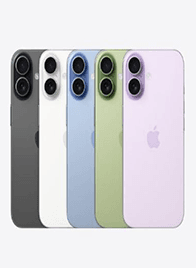
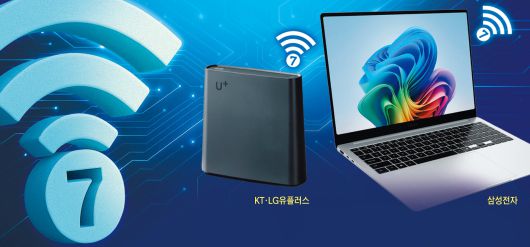
A growing number of devices supporting Wi-Fi 7 are being released into the South Korean market. Samsung Electronics’ Galaxy Book5 Pro laptop and Galaxy S25 smartphone, both launched this year, are equipped to handle the new standard.
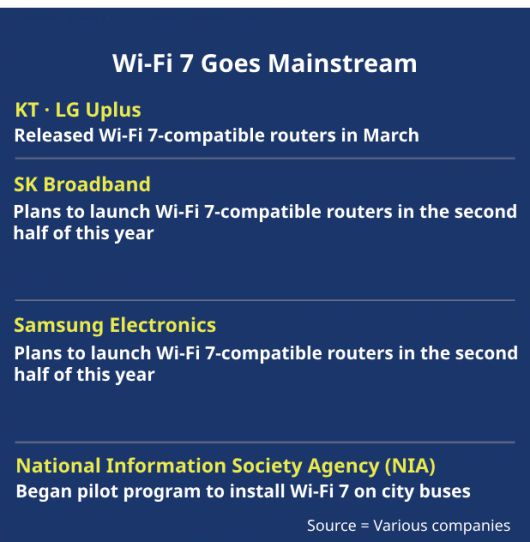
South Korea’s telecom providers are also moving quickly to integrate the technology. KT and LG Uplus began offering Wi-Fi 7-compatible routers to new internet subscribers in March. SK Broadband is expected to launch its own version later this year.
Public infrastructure is also starting to adopt Wi-Fi 7. The National Information Society Agency (NIA) has begun replacing Wi-Fi systems on roughly 100 city buses with Wi-Fi 7-based networks as part of a pilot program slated to run through the second half of the year. Depending on the results, the agency plans to upgrade the networks on approximately 30,000 city buses nationwide beginning next year.
“If Wi-Fi 7 equipment is installed, we expect a significant improvement in wireless connectivity on public buses,” an NIA official said.
[Lee Gi-woo]
- Copyrights ⓒ 조선일보 & chosun.com, 무단 전재 및 재배포 금지 -
 이 기사의 카테고리는 언론사의 분류를 따릅니다.