
 |
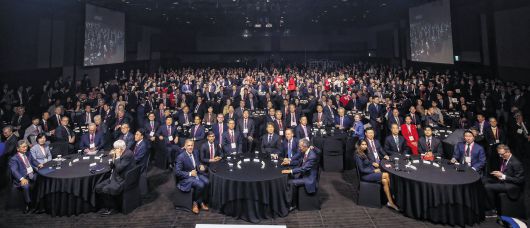
The opening ceremony of the 16th Asian Leadership Conference, hosted by The Chosun Ilbo, takes place at the Shilla Hotel in Seoul on May 21, 2025./Lee Tae-kyung |
The 16th Asian Leadership Conference, themed “The Rise of Nations: Pathways to Great Prosperity,” convened in Seoul this week, drawing prominent global thinkers and political and business leaders. The event comes in a symbolic year marking the 80th anniversary of Korea’s liberation and the 75th anniversary of the start of the Korean War—yet the country now faces one of its most uncertain periods.
With political turmoil that led to an early presidential election and a prolonged spell of near-zero economic growth, South Koreans are increasingly yearning for a new path to prosperity. That urgency becomes even clearer when compared with developments elsewhere in Asia—particularly in Taiwan.
At Computex 2025, Asia’s largest tech exhibition, held in Taipei, Taiwan highlighted its ambitions as a global AI powerhouse. The event, the biggest in more than four decades, showcased the island’s confidence and technological strength. Nvidia CEO Jensen Huang announced plans to build a large-scale AI computing hub in Taiwan, citing partnerships with TSMC and Foxconn to construct AI supercomputers.
TSMC has emerged as the global leader in semiconductor foundry services, while Foxconn—once best known as a key Apple supplier—has repositioned itself as a leading player in AI hardware and infrastructure. These shifts have been made possible by Taiwan’s long-term focus on science and technology education, which has produced a steady pipeline of engineers and skilled workers.
Taiwan now ranks in the global top ten in key metrics of talent competitiveness, including the number of engineering graduates and workforce motivation. That talent base is drawing growing foreign investment. Nvidia is building a new R&D center in Taiwan, while U.S. chipmaker AMD has announced plans for advanced AI and semiconductor research hubs in Kaohsiung and Tainan.
Artificial intelligence is fast becoming the defining infrastructure of the next era, just as electricity and the internet were in previous generations. While South Korea benefits from AI-related exports—SK hynix supplies high-bandwidth memory (HBM) chips to Nvidia—its role in the broader ecosystem remains limited, prompting fears of a “Korea passing” in the global tech race.
Future prosperity will depend on emerging industries. As South Korea loses ground to China in many traditional sectors, success in next-generation technologies has become even more critical. The stakes are high. Without a clear economic future, the country faces a worsening cycle of social challenges—youth unemployment, declining birth rates, brain drain, and growing public frustration.
The new government must confront entrenched interests and push ahead with reforms in regulation, labor and education. Only bold action can lay the groundwork for renewed hope.
[The Chosunilbo]
- Copyrights ⓒ 조선일보 & chosun.com, 무단 전재 및 재배포 금지 -
 이 기사의 카테고리는 언론사의 분류를 따릅니다.


![박나래, 스스로 날려버린 복귀의 길…‘무지’가 빚은 참사 [SS초점]](/_next/image?url=https%3A%2F%2Fthumb.zumst.com%2F256x144%2Fhttps%3A%2F%2Fstatic.news.zumst.com%2Fimages%2F96%2F2026%2F01%2F15%2Fec34f306ee6540869a145887f8e213f0.png&w=384&q=100)