 |
그래픽=박상훈 |
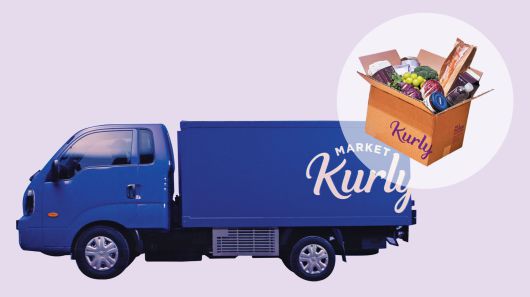
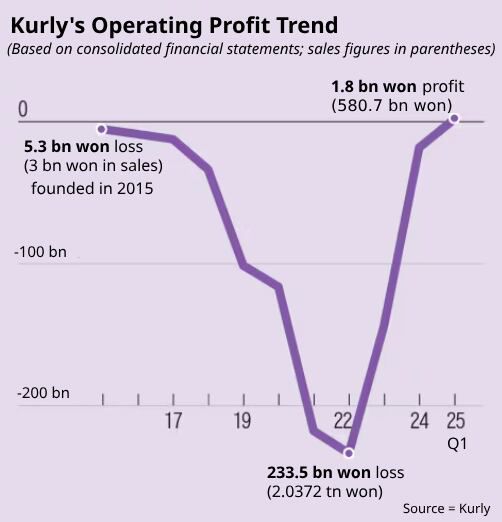
Kurly, a South Korean e-commerce platform specializing in groceries, cosmetics and household goods, recorded an operating profit of 1.76 billion won ($1.3 million) on a consolidated basis in the first quarter—its first quarterly profit since the company was founded a decade ago.
Established in 2015, Kurly introduced “Saetbyeol Delivery,” a next-day early morning delivery service for fresh groceries, which was widely viewed at the time as unfeasible within the country’s retail sector. From the outset, the company poured substantial investments into building logistics centers and hiring overnight delivery workers—a business model that made early profitability nearly impossible.
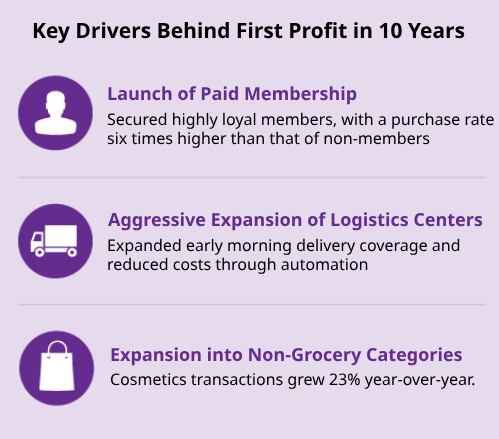
Between 2015 and 2022, Kurly reported annual losses, with the deficit widening year after year. However, the tide began to turn in recent years. Both company insiders and outside observers attribute the turnaround to three key developments over the past three years: the successful introduction of a paid membership program, the expansion into non-grocery categories such as cosmetics, and enhanced operational efficiency at its logistics centers.
Kurly’s path is often compared to that of Coupang, another South Korean e-commerce giant with its own logistics infrastructure. Coupang launched its direct delivery service, Rocket Delivery, in 2014 and reported its first quarterly profit in the third quarter of 2022—eight years later. Like Coupang, Kurly endured years of losses as it aggressively invested in logistics and customer data, but it took even longer to break even.
 |
Graphics by Park Sang-hoon |
Industry analysts pinpoint 2023 as a pivotal year for Kurly. After consistent deficits, the company began to narrow its losses in 2022, setting the stage for profitability the following year.
 |
Graphics by Park Sang-hoon |
In August 2023, Kurly launched its paid subscription program, Kurly Members, setting the monthly fee at 1,900 won—considered the lowest in the domestic retail market. The program offered members a 2,000-won monthly credit, effectively making it free to use, along with access to exclusive coupons, discounts, and curated product offerings. Rather than flooding the platform with a wide array of items, Kurly focused on handpicked, high-quality goods, a strategy that resonated with consumers. Membership quickly surpassed 1.6 million subscribers.
“The renewal rate, a key indicator of member satisfaction and loyalty, is 97 percent,” a Kurly spokesperson said. “Currently, about half of our total revenue comes from members.” The purchase conversion rate—the proportion of site visits that lead to a transaction—is reportedly six times higher among members than non-members, producing a strong lock-in effect.
Within the retail industry, Coupang is frequently likened to a general store, while Kurly is compared to a department store. Coupang’s strength lies in offering a massive selection of products at low prices with rapid delivery. Kurly, in contrast, emphasizes a curated selection of trusted goods.
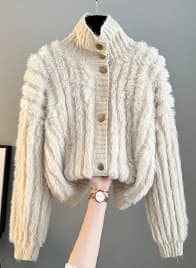
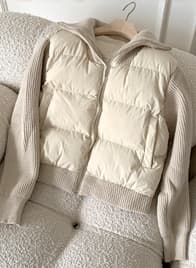
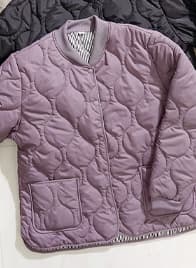
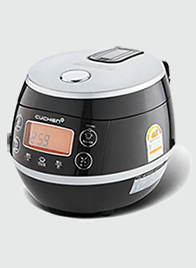
In November 2022, Kurly officially launched “Beauty Kurly,” a dedicated platform for cosmetics. Originally focused solely on groceries, the company has since expanded into cosmetics, kitchenware and home appliances. While Beauty Kurly accounts for roughly 10 percent of the platform’s annual gross merchandise volume, its product category offers higher margins and easier inventory management than perishable foods.
“Kurly built a loyal customer base through one of the most challenging models—overnight fresh food delivery—and then strategically expanded into higher-margin segments such as cosmetics and kitchen goods,” said one retail industry source.
In 2023, Kurly closed its logistics center in Seoul and relocated operations to larger, more advanced facilities in Pyeongtaek and Changwon. The Pyeongtaek logistics hub spans 199,762 square meters—the equivalent of 28 soccer fields. According to the company, the relocation enabled it to broaden its delivery coverage and introduce cutting-edge automation systems, improving productivity by 20 percent and reducing overall costs.
Leveraging its improved logistics infrastructure, Kurly also expanded into third-party logistics (3PL) to lower fixed operating costs. In the first quarter, transaction volume for its fulfillment services—where the company handles delivery for third-party vendors—increased 72 percent year-over-year.
[Seok Nam-jun]
- Copyrights ⓒ 조선일보 & chosun.com, 무단 전재 및 재배포 금지 -
 이 기사의 카테고리는 언론사의 분류를 따릅니다.


![가수 맹유나, 심장마비 돌연사…29세 교수 임용 앞두고 비보 [Oh!쎈 이슈]](/_next/image?url=https%3A%2F%2Fthumb.zumst.com%2F256x144%2Fhttps%3A%2F%2Fstatic.news.zumst.com%2Fimages%2F29%2F2025%2F12%2F26%2Feda5f3b658554aceb5ffad4928852296.jpg&w=384&q=100)

![크리스마스에 전해진 비보…故김영대 돌연 사망, '윤종신→정용화' 가요계 애도 물결 [엑's 이슈]](/_next/image?url=https%3A%2F%2Fthumb.zumst.com%2F256x144%2Fhttps%3A%2F%2Fstatic.news.zumst.com%2Fimages%2F108%2F2025%2F12%2F26%2Ff3d8a2f9e7734063b567b480ef23d115.jpg&w=384&q=100)