 |
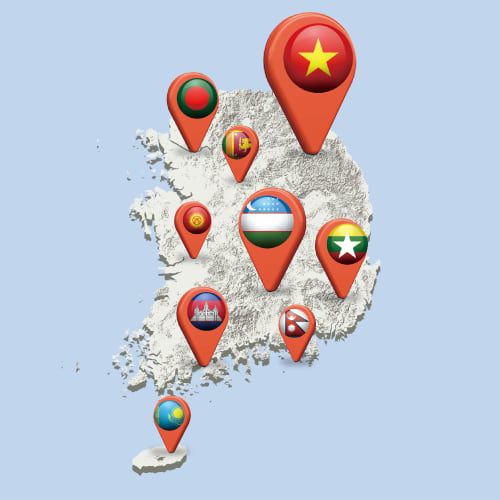
The number of foreign nationals owning real estate in South Korea has surged by more than 50% over the past five years, with Chinese and Southeast Asian buyers driving a sharp rise in property purchases across the greater Seoul area. /Graphic by Kim Hyun-kook |
Nearly 80,000 more foreign nationals have acquired real estate in South Korea over the past five years, bringing the total number of foreign property owners to about 232,000.
During the same period, the number of countries represented among foreign owners increased by 20, reaching 121. That figure accounts for 62.4% of the 194 countries with which S. Korea maintains diplomatic relations.
Foreign buyers have concentrated heavily on properties in the Seoul metropolitan area, with more purchases recorded in Gyeonggi-do (Province) than in the capital itself.
As of last month, 83,974 foreign nationals owned property in Gyeonggi, accounting for 36% of the total. Seoul followed with 46,770 owners (20.1%), and Incheon with 20,437 (8.8%). In total, the greater Seoul area made up 64.9% of all foreign real estate ownership in the country.
According to court registry data analyzed by The Chosun Daily on May 19, the number of foreign property owners in S. Korea stood at 232,951 as of last month. That represents a 52.2% increase from April 2020, when the total was 153,083.
More than half of the increase—about 42,000 people—were Chinese nationals. In addition, the number of owners from Southeast Asian countries such as Vietnam, Myanmar, and Laos rose sharply, in some cases by more than sevenfold. Central Asian countries like Uzbekistan and Kazakhstan also saw large increases, with ownership rising up to nearly seven times.
Some analysts attribute the increase to a rise in overseas workers filling physically demanding and often overlooked roles in sectors like construction and manufacturing—commonly known as “3D jobs.”
According to the Ministry of Justice, the number of foreign residents holding work-related visas reached approximately 567,000 last year, up 25% from 2020.
Gyeonggi-do, where housing is generally more affordable than in Seoul, was also found to have the most diverse mix of foreign property owners.
Foreign nationals from 91 countries owned property in the province, compared to 86 in Seoul. This is seen as a reflection of the tendency among foreign workers to settle in regions with lower housing costs.
As of last month, real estate in S. Korea was held by citizens from 121 countries, up from 101 in Apr. 2020. The increase included countries such as Bhutan and Brunei in Southeast Asia, Mali, Benin and Cameroon in Africa, and Dominica, Antigua and Barbuda, and Jamaica in the Caribbean.
As of last month, real estate in S. Korea was held by citizens from 121 countries, up from 101 in Apr. 2020. The increase included countries such as Bhutan and Brunei in Southeast Asia, Mali, Benin and Cameroon in Africa, and Dominica, Antigua and Barbuda, and Jamaica in the Caribbean.
Several European nations, including Malta, Moldova, and Lithuania, also newly appeared on the list. By the end of last year, the count had reached 120, and rose to 121 this February when a citizen of Cabo Verde purchased land in the Gogang-dong neighborhood of Bucheon.
Among Southeast Asian countries, Vietnam recorded the sharpest increase. The number of Vietnamese property owners rose from 922 in 2020 to 2,959—a 3.2-fold jump.Bangladeshi and Cambodian ownership rose by 3.9 and 2.7 times, respectively, to 150 in each case. Nepal added 122 owners, and Sri Lanka 61—both reflecting high growth rates.
Central Asian ownership also expanded notably. Uzbekistani nationals went from 281 to 1,230 over five years, a 4.4-fold increase, while Kazakhstani owners surged from 43 to 300—nearly sevenfold. These trends appear linked to the growing presence of Central Asian workers in apartment construction, moving services, and other labor-intensive sectors.
A representative from a real estate agency that serves foreign clients said that, in some cases, parents in Southeast Asia are helping finance homes for their children studying in S. Korea. While still limited, this kind of family-funded investment is reportedly on the rise.
Property ownership also increased among nationals of countries currently at war. The number of Ukrainian owners rose from 27 to 74, while Syrian ownership grew from 55 to 182.
Chinese citizens remained the largest group of foreign property holders in S. Korea. Their numbers jumped from 54,320 in 2020 to 96,955 as of last month, an increase of 78.5%. Their share of total foreign ownership also rose—from 35.5% to 41.6%.
In contrast, the number of American owners grew from 59,710 to 79,598, up 33.3%. However, their overall share dropped from 39% to 34.2%.
[Lee Tae-dong]
- Copyrights ⓒ 조선일보 & chosun.com, 무단 전재 및 재배포 금지 -
 이 기사의 카테고리는 언론사의 분류를 따릅니다.


!["父 살해 후 시신에 케첩 뿌린 이유는"…도주 중 '또' 살인[그해 오늘]](/_next/image?url=https%3A%2F%2Fthumb.zumst.com%2F256x144%2Fhttps%3A%2F%2Fstatic.news.zumst.com%2Fimages%2F24%2F2025%2F12%2F28%2Ff34da7fa63c646c689d5e96fe96635c0.jpg&w=384&q=100)

!["전 남친과 한번만 더 자고 싶다"..시한부 아내의 마지막 소원 [어떻게 생각하세요]](/_next/image?url=https%3A%2F%2Fthumb.zumst.com%2F256x144%2Fhttps%3A%2F%2Fstatic.news.zumst.com%2Fimages%2F14%2F2025%2F12%2F27%2Fb817421c227348fa83bdf32024069607.jpg&w=384&q=100)