 |
With just over two weeks remaining until the June 3 presidential election, the race is shaping up as a two-way contest between Democratic Party candidate Lee Jae-myung and People Power Party’s Kim Moon-soo. While Lee maintains a lead, the possibility of a conservative unification between Kim and New Reform Party’s Lee Jun-seok could narrow the gap significantly.
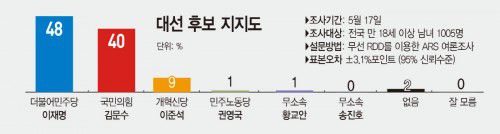
According to a poll conducted by the Korea Public Reputation Research Institute (KOPRA) at the request of Asia Today on May 17, Lee led with 48% support, followed closely by Kim at 40%. This marked Kim’s first time reaching the 40% threshold in KOPRA’s polling. Both candidates gained one percentage point from the previous survey on May 13, keeping the 8-point margin unchanged.
Although Lee initially appeared to hold a commanding lead, the start of the official campaign period has coincided with a decline in the political shock of martial law and impeachment controversies. As a result, the race is now drawing closer to a 51-to-49 dynamic between blocs.
Meanwhile, Lee Jun-seok of the New Reform Party, championing a “40s-generation leadership” narrative, garnered 9% support—continuing a steady rise from 7% in early May and 8% in the previous poll. If his support surpasses 10%, calls for unification within the conservative camp are expected to grow louder. Combining support for Kim and Lee Jun-seok gives conservatives a collective 49%, slightly ahead of Lee Jae-myung.
Among moderates—considered a crucial swing bloc—Lee led Kim by just 6 percentage points (45% to 39%), with Lee Jun-seok capturing 13%, 4 points higher than his overall average. Among self-identified conservatives, 68% supported Kim and 10% backed Lee Jun-seok. Among progressives, Lee Jae-myung enjoyed overwhelming support at 80%.
By region, Busan, Ulsan, and South Gyeongsang saw a tight race, with Lee at 48%, Kim at 44%, and Lee Jun-seok at 6%. In Daejeon, Sejong, and Chungcheong, Lee polled at 48% and Kim at 41%. Kim led slightly in Seoul with 44% compared to Lee's 41%, while in Incheon and Gyeonggi Province, Lee held a wider lead—50% to Kim’s 37%.
Age-based trends showed narrower margins among younger voters. In their 30s, Lee led Kim 45% to 38%. Among voters in their 20s, Kim led Lee 35% to 30%, while Lee Jun-seok secured 27% in this demographic and 14% among those in their 30s, cementing his status as a prominent young conservative.
ⓒ "젊은 파워, 모바일 넘버원 아시아투데이"
 이 기사의 카테고리는 언론사의 분류를 따릅니다.