 |
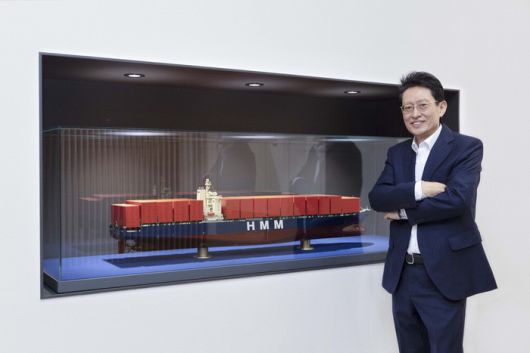
CEO Choi Won-hyuk |
HMM Co., South Korea‘s largest container shipping line, plans to expand infrastructure investments for growth, according to its new Chief Executive Officer Choi Won-hyuk.
“We plan to expand investments in infrastructures, such as shipping terminals and container freight stations (CFS),” Choi said, in an interview with Maeil Business Newspaper. “HMM currently lacks exclusive terminals at major ports, including on the U.S. West Coast.”
Choi noted that the company has eight terminals worldwide, but many are not practically usable.
“We must actively invest in key overseas ports, such as Santos in Brazil,” he said.
The company plans to explore various investment options like joint equity investments with shipping alliances and cooperation with the Korea Ocean Business Corporation.
Choi, former president of LX Pantos Co., was appointed as HMM’s new CEO at the end of March.
Choi is recognized as Korea’s top logistics expert, having spent over 40 years working across various logistics sites at companies like CJ Logistics and LX Pantos.
During his eight years as CEO at LX Pantos starting in 2015, he expanded the global logistics network and improved operational efficiency, growing the company’s sales from 2 trillion won ($1.39 billion) to over 10 trillion won.
Choi is regarded as a leader with the strategy and execution ability to elevate HMM into a top global shipping company.
HMM faces a host of challenges, both external and internal – from global risks such as cargo volume decline due to U.S. President Donald Trump’s tariff policies, to internal issues like privatization and the potential acquisition of SK Shipping.
Below are excerpts from the interview
Q. What is the most urgent task after taking office?
A. We plan to expand infrastructure investments, including shipping terminals and CFS. HMM currently lacks exclusive terminals at major ports. … Domestically, there is also a shortage of terminals that can accommodate large vessels, making it essential to secure new terminals, such as at the planned Jinhae New Port.
Q. Last year’s privatization attempt failed.
A. I believe privatization is a mission that must be completed during my term. However, due to HMM’s large size, selling the public stake to a single company at once is not easy.
Few companies can afford the acquisition cost of over 10 trillion won, given that Korea Development Bank and KOBC collectively hold about 71.7 percent of HMM shares.
Privatization will be decided through consultation between the government and major shareholders. Personally, I believe a model like Germany’s Hapag-Lloyd, the world’s fifth-largest shipping company operated jointly by public and private sectors, could be a realistic alternative.
Under this model, part of the public stake is sold, and the company is jointly operated with private partners, balancing public interest with operational efficiency. Most importantly, as shipping is a national key industry, we must consider industrial stability and national competitiveness, not just a simple sale.
Q. In January, HMM was selected as the preferred bidder to acquire certain business divisions of SK Shipping. What is the current status?
A. Since we have not yet reviewed the due diligence results, it is too early to say definitively whether we will proceed with the acquisition.
The biggest concerns are workforce and labor union issues. Private equity funds have suppressed wage increases, so if the acquisition is completed, demands for wage hikes and labor-management conflicts could erupt.
It is important that the acquirer understands the nature of the shipping industry and avoids drastic changes to the workforce. We will carefully decide after reviewing the due diligence results after May.
Q. There are signs that U.S.-China cargo volumes are declining due to Trump-era tariffs. How will you respond?
A. We must enter new markets, such as Africa and the Middle East. In Africa, logistics demand is growing in major countries like Kenya, Tanzania, and South Africa, but shipping routes are still limited.
Intra-Asia markets are dominated by small Korean shipping companies, which is an area where HMM is relatively weak. We are also considering developing new routes to Europe and South America.
For new market entry, we are reviewing strategies such as deploying small vessels and forming local partnerships.
Q. Do you have plans for organizational restructuring?
A. We plan to proceed carefully after thoroughly listening to field opinions. My goal is to create a workplace culture and welfare system that makes HMM a company people want to work for, competitive even compared to global peers.
During my eight years at Pantos, I transformed the organizational culture through town halls and direct communication with employees. Initiatives included dress code liberalization, reducing unnecessary overtime, and fostering direct communication between employees and leadership.
 이 기사의 카테고리는 언론사의 분류를 따릅니다.


!['처가 손절' 이승기, 결혼 3년 차에 결국 해외로 떠났다…"이홍기와 잘 어울릴 듯" ('체인지')[종합]](/_next/image?url=https%3A%2F%2Fthumb.zumst.com%2F256x144%2Fhttps%3A%2F%2Fstatic.news.zumst.com%2Fimages%2F77%2F2025%2F12%2F28%2F354e2df0b73e4a63b54417b9c52ed72c.jpg&w=384&q=100)

!['10살 연하♥' 김영희, 결혼 5년 차에 안타까운 소식 전했다…임산부로 오해받아 ('말자쇼')[종합]](/_next/image?url=https%3A%2F%2Fthumb.zumst.com%2F256x144%2Fhttps%3A%2F%2Fstatic.news.zumst.com%2Fimages%2F77%2F2025%2F12%2F28%2F21164ca8c55c4a09b01a95cbdfb6f3b7.jpg&w=384&q=100)