A court order issued on Dec. 31, along with an arrest warrant for President Yoon Suk-yeol, has sparked controversy for excluding key provisions of South Korea’s Criminal Procedure Act. The search warrant for the presidential residence specified that provisions requiring consent for searches of military or government-classified locations would not apply. This unprecedented directive has drawn sharp criticism from legal experts.
Legal experts have called the decision highly irregular, with one noting, “This type of warrant is unheard of. For a judge to exclude specific legal provisions, rather than define the scope or methods of the search, encroaches on legislative authority and violates the principle of separation of powers.”
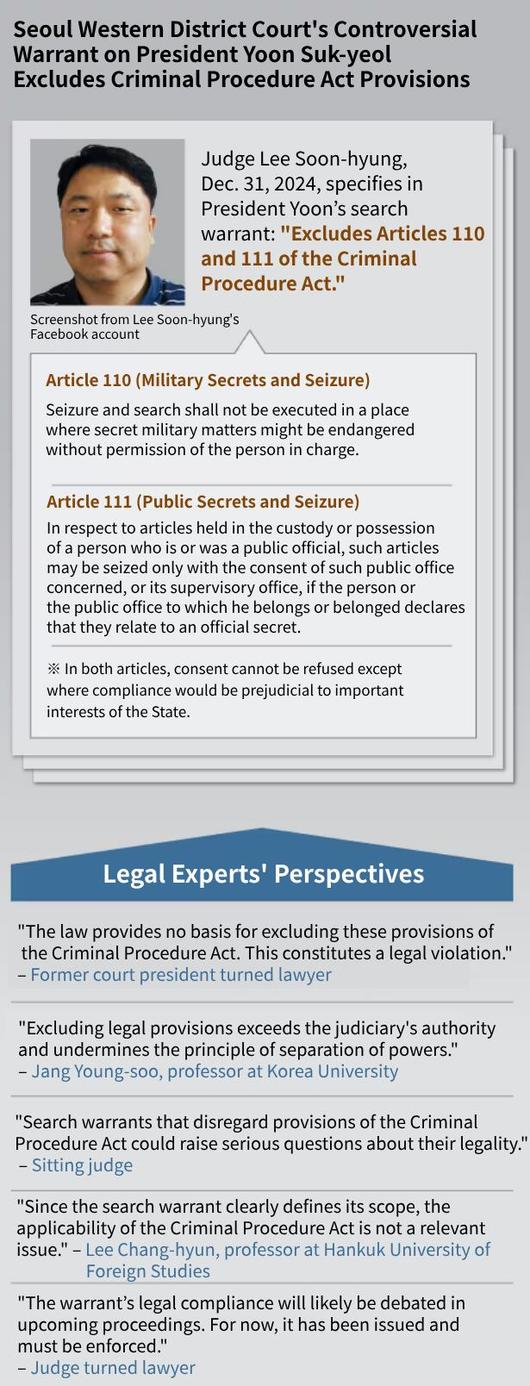
Sources revealed that Judge Lee Soon-hyung, who oversees warrants at the Seoul Western District Court, issued the search warrant requested by the Corruption Investigation Office for High-ranking Officials (CIO). In the warrant, Judge Lee explicitly excluded Articles 110 and 111 of the Criminal Procedure Act, which mandate that searches of military or public service sites classified as confidential require consent from the responsible parties unless such consent would compromise the nation’s critical interests.
Legal experts have called the decision highly irregular, with one noting, “This type of warrant is unheard of. For a judge to exclude specific legal provisions, rather than define the scope or methods of the search, encroaches on legislative authority and violates the principle of separation of powers.”
Sources revealed that Judge Lee Soon-hyung, who oversees warrants at the Seoul Western District Court, issued the search warrant requested by the Corruption Investigation Office for High-ranking Officials (CIO). In the warrant, Judge Lee explicitly excluded Articles 110 and 111 of the Criminal Procedure Act, which mandate that searches of military or public service sites classified as confidential require consent from the responsible parties unless such consent would compromise the nation’s critical interests.
President Yoon’s legal representative, Yun Gap-geun, strongly criticized the warrant, stating, “The Criminal Procedure Act does not authorize judges to disregard these provisions. This is a serious issue that undermines public trust in the judiciary.” Yun has filed a constitutional complaint with the Constitutional Court and requested an investigation and disciplinary action against Judge Lee from the Supreme Court.
Judge Lee’s decision to exclude Articles 110 and 111 is widely viewed as a move to prevent the Presidential Security Service from obstructing the warrant’s execution. The CIO sought both an arrest warrant for President Yoon, citing his failure to respond to three summonses on Dec. 30, and a search warrant for the presidential residence to locate him.
Historically, the Presidential Security Service has invoked Articles 110 and 111 to deny search requests for the residence, citing the provisions requiring consent. Similarly, past searches of South Korea’s Blue House were denied under the same provisions, with requested materials being voluntarily submitted instead. Judge Lee’s exclusion of these provisions appears to be aimed at ensuring the security service could not interfere with the arrest.
 |
Graphics by Yang In-sung |
Legal experts warn that this decision sets a troubling precedent. While courts typically issue search warrants with clear parameters, such as specific locations, time limits, and detailed items, excluding the application of legal provisions entirely is virtually unheard of.
“Search warrants must be grounded in the Constitution and applicable laws,” said Korea University Law School Professor Jang Young-soo. “For a judge to unilaterally disregard a law exceeds judicial authority and violates the separation of powers.” A senior prosecutor echoed this sentiment, stating, “This is the first time I’ve encountered such a warrant. It is unclear whether a judge has the authority to restrict the application of laws, as this falls squarely within the legislative domain.”
[Yoo Hee-kon]
- Copyrights ⓒ 조선일보 & chosun.com, 무단 전재 및 재배포 금지 -
 이 기사의 카테고리는 언론사의 분류를 따릅니다.


![가수 맹유나, 심장마비 돌연사…29세 교수 임용 앞두고 비보 [Oh!쎈 이슈]](/_next/image?url=https%3A%2F%2Fthumb.zumst.com%2F256x144%2Fhttps%3A%2F%2Fstatic.news.zumst.com%2Fimages%2F29%2F2025%2F12%2F26%2Feda5f3b658554aceb5ffad4928852296.jpg&w=384&q=100)


![크리스마스에 전해진 비보…故김영대 돌연 사망, '윤종신→정용화' 가요계 애도 물결 [엑's 이슈]](/_next/image?url=https%3A%2F%2Fthumb.zumst.com%2F256x144%2Fhttps%3A%2F%2Fstatic.news.zumst.com%2Fimages%2F108%2F2025%2F12%2F26%2Ff3d8a2f9e7734063b567b480ef23d115.jpg&w=384&q=100)