
 |
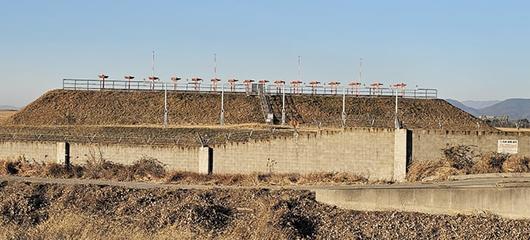
Large concrete embankment at Yeosu Airport – A localizer, over 4 meters tall, seen atop a soil-covered concrete embankment near the runway at Yeosu Airport, Jeollanam-do. /Jin Chang-il |
The investigation into the tragic crash of a Jeju Air passenger plane at Muan International Airport has identified the primary cause as a concrete embankment at the end of the runway. The plane, which performed an emergency belly landing, collided with the embankment holding a localizer—a key navigation system for landings—triggering an explosion that escalated the incident into a fatal disaster. Despite the severity of the crash, the Ministry of Land, Infrastructure and Transport (MOLIT) stated on Jan. 1 that it is still “reviewing” whether the localizer structure at Muan Airport complies with existing regulations. Four days after the accident, officials have yet to clarify the safety standards.
Localizers, which provide lateral guidance to pilots during landings, are typically constructed with materials designed to shatter upon impact, reducing the risk of catastrophic damage—a practice aligned with international safety standards. For instance, in 2015, a South Korean passenger plane that overran a runway at a Japanese airport passed through a breakable localizer, enabling all passengers to survive. However, at Muan Airport, the localizer was mounted on a two-meter-high concrete-reinforced embankment. Experts have criticized the unusual structure near a runway, noting that even experienced pilots would not anticipate its placement. Aviation specialists, both domestic and international, have labeled the situation as “borderline criminal.” Without the embankment, the accident might have resulted in an extraordinary escape rather than a catastrophe.
Initially, MOLIT claimed the embankment did not violate regulations, asserting it was outside the zone requiring breakable materials. Yet, when conflicting guidelines emerged, suggesting the concrete structure was within the regulated area, the ministry shifted its position, stating the matter was “under review.” This debate is not merely about technicalities; it underscores a critical lapse in prioritizing safety. MOLIT has also highlighted that the embankment has been in place since the airport’s opening in 2007, seemingly deflecting accountability for the incident.
The problem extends beyond Muan. Similar hazardous structures exist at other South Korean airports. At Yeosu Airport, a localizer is installed on a four-meter-high embankment just 300 meters from the runway’s end. Pohang-Gyeongju Airport has a two-meter embankment, while Gwangju Airport’s stands at 1.5 meters, all featuring embedded concrete slabs. In response, MOLIT has announced a nationwide inspection of localizer installations. However, as regulations remain ambiguous and inspections continue, the risk of similar tragedies looms. Swift and decisive action to remove these dangerous structures must take precedence to prevent further disasters.
[The Chosunilbo]
- Copyrights ⓒ 조선일보 & chosun.com, 무단 전재 및 재배포 금지 -
 이 기사의 카테고리는 언론사의 분류를 따릅니다.


!["父 살해 후 시신에 케첩 뿌린 이유는"…도주 중 '또' 살인[그해 오늘]](/_next/image?url=https%3A%2F%2Fthumb.zumst.com%2F256x144%2Fhttps%3A%2F%2Fstatic.news.zumst.com%2Fimages%2F24%2F2025%2F12%2F28%2Ff34da7fa63c646c689d5e96fe96635c0.jpg&w=384&q=100)