 |
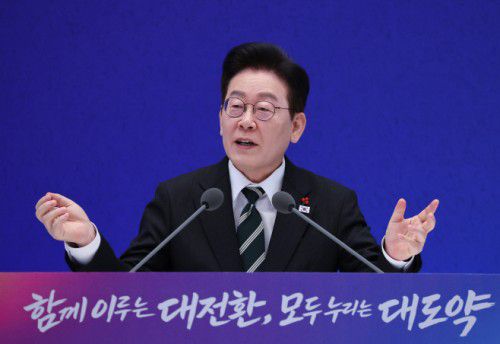
President Lee Jae-myung speaks at a New Year press conference held at the State Guest House of Cheong Wa Dae on Jan. 21. / Yonhap |
The first year of the Lee Jae-myung administration’s national interest–centered “pragmatic diplomacy” has marked a turning point for the sustainability of South Korea’s foreign policy, analysts say, by harmonizing values and interests to maximize national gains.
Since taking office in June last year, President Lee Jae-myung has steered the country back onto the global diplomatic stage, expanding flexibility through a realistic approach amid a rapidly shifting international landscape. Polls suggest this pragmatic diplomacy has also underpinned Lee’s steady approval ratings.
‘Korea is back’ on the world stage
The previous administration was criticized for narrowing diplomatic autonomy by prioritizing values-based diplomacy, a course that weakened ties with China and Russia and reduced South Korea’s economic interests and leverage over North Korea.
Following a leadership vacuum triggered by the Dec. 3 martial law episode and the return of U.S. President Donald Trump to the White House—accelerating a broader reordering of the global system—the Lee government moved swiftly to normalize South Korea’s diplomacy through a pragmatic strategy.
Min Jeong-hoon, a professor at the Korea National Diplomatic Academy, said in a report titled One Year of the Lee Jae-myung Administration: Diplomatic Achievements and Tasks Ahead that the most significant accomplishment of the first year was the normalization of South Korea’s foreign policy.
A highlight was the 2025 Asia-Pacific Economic Cooperation (APEC) summit in Gyeongju. South Korea chaired 14 official consultations, mediated differences among member economies, and led the adoption of three key documents—the APEC Leaders’ Declaration, the APEC AI Initiative, and a cooperation framework addressing demographic change—showcasing the substance of pragmatic diplomacy.
Expanding outreach on a firm alliance footing
Safeguarding the Korean Peninsula and protecting citizens’ lives and property remain South Korea’s core national interests. With North Korea’s advancing nuclear and missile capabilities posing a persistent threat, the Lee administration has strengthened cooperation with the United States.
Built on a solid South Korea–U.S. alliance, the government has also reinforced trilateral cooperation among South Korea, the U.S. and Japan, while engaging China and Japan separately to emphasize that diplomacy is driven by practical cooperation rather than ideology or public sentiment.
Looking ahead, the administration aims to extend pragmatic diplomacy across the Indo-Pacific and beyond—stabilizing relations with the U.S., Japan and China, while strengthening ties with ASEAN, the Middle East and Africa based on openness, inclusiveness and solidarity.
“Pragmatic diplomacy centered on national interests enables an approach that spans ideological lines and provides a stable foreign policy foundation across domestic political divides,” Min said. “If public support is sustained and Korea’s comparative advantages in trade, advanced technology, development cooperation, energy, defense industries, culture and people-to-people exchanges are fully leveraged, South Korea can be recognized as a model advanced nation on the global stage.”
ⓒ "젊은 파워, 모바일 넘버원 아시아투데이"
 이 기사의 카테고리는 언론사의 분류를 따릅니다.


![박신혜, 반지하 생활→데뷔 결심..“배우하면 돈 多 벌겠다 생각” (‘유퀴즈’)[핫피플]](/_next/image?url=https%3A%2F%2Fthumb.zumst.com%2F256x144%2Fhttps%3A%2F%2Fstatic.news.zumst.com%2Fimages%2F29%2F2026%2F01%2F22%2Fda8c894e432041fda617bd3b2f8cb217.png&w=384&q=100)