 |
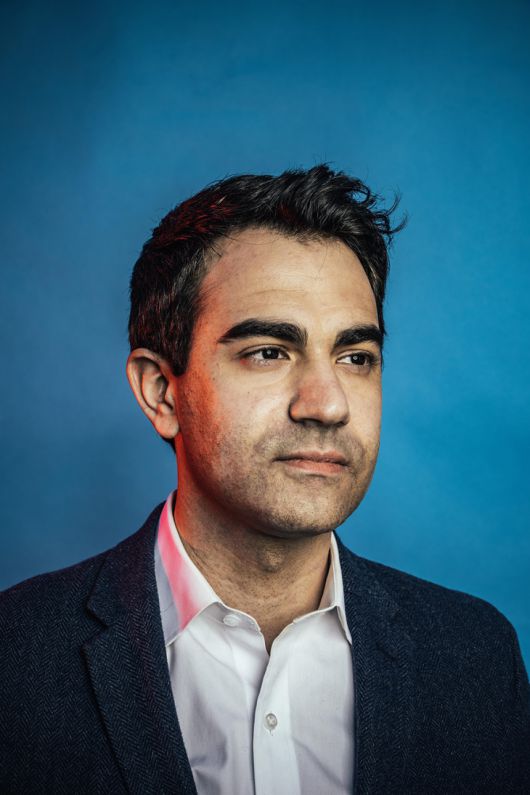
Stephen Wertheim, a senior fellow at the Carnegie Endowment for International Peace. |
The past year, since U.S. President Donald Trump returned to the White House, has been a relentless succession of the unpredictable. He weaponized tariffs, turning them against allies as readily as adversaries. He invited Russian President Vladimir Putin to Alaska and greeted him like an old friend, and—defying his reputation as an “isolationist”—ordered airstrikes on Iran’s nuclear facilities. Trump has given no one time to even take stock of his first year back in office. At the very start of the new year, he has launched an attack on Venezuela and is openly stoking ambitions to seize Greenland by force if necessary.
Asked to choose words that best describe the Trump administration’s foreign policy over the past year, Stephen Wertheim, a senior fellow at the Carnegie Endowment for International Peace, responded in an email interview with the Kyunghyang Daily News on January 19: “Thuggish. Extortionate. Frenzied. Myopic.” Wertheim is also a co-founder of the Quincy Institute for Responsible Statecraft and the author of Tomorrow, the World: The Birth of U.S. Global Supremacy, which Foreign Affairs selected as its “Book of the Year”.
Wertheim said that President Trump is “offering an enthusiastically naked imperialism,” adding that “even U.S. allies must now prepare to stand up to Washington’s bullying.”
KYUNGHYANG: The operation to capture Nicolas Maduro came as a shock in that it appeared to mark a return to an era in which “might makes right.” What do you believe the Trump administration’s attack on Venezuela signifies for the international order?
WERTHEIM: Trump’s attack on Venezuela is hardly the first time the United States has used military force aggressively and in violation of international law. What is different is that Trump makes little-to-no attempt even to claim he’s acting for a higher principle. He says his main motive for turning gunboats on Caracas is to “take the oil.” I believe him. He is currently threatening to strike multiple countries and annex the sovereign territory of other states, including NATO allies. He may well do that.
When they went to war, Trump’s predecessors not only claimed to be improving the international order; they also believed what they said — perhaps to a fault. But if traditional U.S. presidents sometimes allowed liberal ordering to turn into liberal imperialism, Trump is offering enthusiastically naked imperialism.
For the world, Trump’s conduct means that power politics has become an inescapable reality. Weak countries can count on Trump to boss them around. Even American allies must now prepare to stand up to Washington’s bullying. The effect on U.S. adversaries, namely China and Russia, remains to be seen; they don’t need America’s permission to act as they like. At a minimum, however, Trump has helped Beijing to present itself as the responsible steward of international order and more easily justify its own coercion, present and future. He has further lowered the bar Moscow needs to clear to appear less bad, in the eyes of many across the Global South, than the United States and the West.
KYUNGHYANG: President Trump has also suggested the possibility of using military force against Greenland. Following the bombing of Iranian nuclear facilities and the apparent success of the Venezuela operation, some argue that Trump may have developed a sense of confidence — or even efficacy — in the use of military force. How far do you think he may be willing to expand the use of force going forward?
WERTHEIM: Trump is emboldened. He has ordered a succession of attacks that might have caused immediate blowback but didn’t — so far. The trend began with his assassination of Iranian commander Qassem Soleimani in the last year of his first term. Now, in his second term, he has bombed Iran, blown up alleged drug boats in the Caribbean basin, and launched airstrikes in Syria and Nigeria, all before the raid to capture Maduro. Trump still prefers to take one-and-done military actions and avoid the commitment of ground forces. But he probably thinks that the doubters kept warning of risks, and each time he proved them wrong, avoiding the quagmires that bedeviled other presidents. I fear that his luck will run out, and he may order more and more ambitious operations.
KYUNGHYANG: Trump’s announcement of plans to impose tariffs on eight European Union countries that oppose the U.S. annexation of Greenland has pushed the transatlantic alliance into what many see as its gravest crisis to date. What do you believe the future holds for the transatlantic alliance and NATO?
WERTHEIM: Trump’s quest to annex Greenland has the potential not only to fracture the transatlantic alliance but to divide Europe as well. If Trump keeps intensifying pressure on Denmark to sell the territory, the European countries who rely the most on U.S. military protection may urge Copenhagen to appease Trump, while other European countries may find that prospect unconscionable. So Europe could effectively split into two camps, with the United States siding with one against the other.
However the Greenland affair turns out, NATO will never be the same. Major European countries, including France and Germany, have learned they cannot remain dependent on the United States — not under Trump and not after Trump. Not only is American power unreliable, but it is liable to turn into a dagger aimed at your heart. I can imagine several possible futures for the transatlantic alliance, but the next decade won’t look like the last.
KYUNGHYANG: For years, Latin America was treated as a low-priority region in major U.S. strategic documents. Yet in the Trump administration’s latest National Security Strategy, the Western Hemisphere is designated as a top strategic priority. Why do you think the Trump administration, unlike previous administrations, is placing such emphasis on the Western Hemisphere?
WERTHEIM: Consider three levels: Trump, his administration, and the world.
Trump has all along felt that the most grievous threats to the United States traverse the nation’s borders. Immigrants, gangs, drugs, and even, less directly, trade — Trump securitizes these issues and prioritizes them above conventional military threats far away. That worldview has put Trump on a collision course with America’s hemispheric neighbors.
Yet it’s only in his second presidency that the Western Hemisphere has ascended to the top of U.S. strategic priorities. That’s because Trump has finally surrounded himself with likeminded or obedient advisers willing to implement his vision. In part because his vision is capacious, his administration contains several factions who compete over most areas of foreign policy. On the Western Hemisphere, however, the factions overlap. “Primacists” such as Secretary of State Marco Rubio can agree with “restrainers,” who favor U.S. military pullbacks overseas, that the United States should show greater concern with challenges close to home.
And now that the United States has lost a position of dominance in Europe and Asia, the Western Hemisphere has reemerged as a fresh-seeming terrain in which to wield American power. Trump prefers to deal with the weak, and Trump isn’t alone: the United States has sought to achieve uncontested global supremacy ever since the Cold War ended. Today Washington can no longer enjoy the same position worldwide, but it can dominate what the Trump administration calls “our hemisphere.”
KYUNGHYANG: Trump and the MAGA movement have long been described as isolationist. Yet Trump has intervened extensively abroad, calling into question whether that label remains analytically useful. He once appeared to approach the use of power like a businessman weighing costs and returns, but he now seems increasingly willing to assert power for its own sake. How would you characterize the underlying logic or strategy of Trump’s foreign policy?
WERTHEIM: Trump has never been an isolationist; he wants to take things from the world, not withdraw from it. Nor does Trump make careful calculations of costs and benefits. He has always been a showman more than a businessman, and as president, he is guided above all by the performance of power. He wants to tell Americans, the world, and perhaps himself that he is in control and getting his way. More specifically, he is performing his vision of “peace through strength,” which involves both ending armed conflicts and using military force in targeted ways to display American might.
The irony is that Trump is supposed to put “America first” in all things, yet he lacks a coherent account of what American interests are. At least the original so-called isolationists of 1940 and 1941 had an identifiable understanding of U.S. interests: they contended that so long as the United States kept outside powers out of the Western Hemisphere, North America would remain secure from attack. They were not necessarily wrong on that point, even though their prescription might have been terrible for the world. Trump, by contrast, chafes at the global commitments he has inherited but has yet to relinquish any of them.
KYUNGHYANG: The new National Security Strategy(NSS) does not contain systemic criticism of China or Russia. Some analysts note that this is the first NSS since 1988 that does not reference China’s authoritarianism even once. What do you think this shift signifies?
WERTHEIM: The National Security Strategy makes almost no distinction between democratic and authoritarian states. Under Trump’s predecessors, however, the United States has opposed Russia and China not only because they were authoritarian, but also, and mainly, because they threaten American primacy, including U.S. allies.
The new National Security Strategy does not take the accommodating view of China that some analysts have suggested. True, it avoids adversarial verbiage toward China. Yet it offers Beijing no concessions — nothing but the chance to accept coexistence on Washington’s terms. In particular, the document states that Taiwan is strategically and economically important to the United States and promises to “build a military capable of denying aggression anywhere in the First Island Chain.” While it seems Trump wants to avoid needlessly antagonizing Beijing through rhetoric, U.S.-China competition is continuing.
KYUNGHYANG: But some experts argue that the era of hegemonic competition is coming to an end, and that the United States, China, and Russia may be moving toward a great-power arrangement that tacitly recognizes spheres of influence. Do you agree with this interpretation?
WERTHEIM: I essentially disagree. Trump has reclaimed America’s traditional sphere of influence in the Western Hemisphere, but that does not mean he’s willing to grant China or Russia spheres in their own regions. The normal hypocrisy of U.S. foreign policy is: “spheres of influence for me, but not for thee.” If that hypocrisy hasn’t bothered other presidents, it certainly won’t bother Trump.
Trump has not offered to cede a sphere of influence to Beijing or Moscow in their regions. He hardly welcomed the expansion of Chinese power in the Indo-Pacific. Trump has, of course, supported Russia’s demand to retain the territory it currently occupies in Ukraine, plus the rest of the Donetsk region, but in that case Trump seems to be attempting to reach a pragmatic end to the war rather than grant Russia a wider sphere of influence in eastern Europe or Central Asia.
In short, Trump is asserting American power globally, not pulling the United States back to its own hemisphere. That said, Trump may yet make some sort of deal over Taiwan or diminish U.S. defense responsibilities in Europe. He may also weaken the foundations that generate American power over the long term, including the country’s international attractiveness and state capacity. In a decades’ time, the United States may well have a more modest global military presence and fewer defense commitments. But even if that happens, the United States will remain a major security player in Asia and the Western Hemisphere at a minimum, and I doubt that Russia could rampage through much of eastern Europe.
KYUNGHYANG: North Korea is not mentioned even once in the new NSS. This has led to speculation in South Korea that the United States may have effectively accepted the practical impossibility of North Korean denuclearization and downgraded the priority of the nuclear issue. What is your assessment?
WERTHEIM: As Barack Obama left office a decade ago, he told Trump that North Korea was the most pressing threat the new president would face. Since Trump failed to make a nuclear deal with Kim Jong-un in 2019, North Korea has dropped far down Washington’s list of foreign policy priorities. The new National Security Strategy reflects that reality.
In my view, the United States has all but accepted the practical impossibility of fully denuclearizing North Korea, even though it hasn’t officially said so. There is no realistic scenario in which North Korea will decide to relinquish its nuclear arsenal.
The Biden administration effectively sought to strengthen deterrence and manage risk, not to advance toward denuclearization. Trump personally seems to want to return to the negotiating table with Kim Jong-un as part of his attempt to be the “president of peace.” But there are no signs of what Trump would be willing to offer Kim, and Kim’s asking price, if there is one, has gone up due to his partnership with Russia and distrust of the United States.
KYUNGHYANG: The new NSS emphasizes that the United States will no longer bear security burdens unilaterally, calling on allies to share responsibility. It specifically highlights the roles of South Korea and Japan in the Indo-Pacific, including the defense of the First Island Chain. In the event of a contingency involving Taiwan, what strategic role does the United States expect South Korea to play?
WERTHEIM: I don’t think many people in the U.S. government expect South Korea to join a U.S.-led coalition to fight China. (Nor is it knowable whether the United States would fight China; “strategic ambiguity” isn’t just a policy but a real reflection of U.S. intention, or lack thereof.) Instead, South Korea would be expected to provide logistical support for allied forces and produce defense equipment to sustain the war effort. Most importantly, South Korea would need to assume the full burden of deterring North Korea even as some U.S. forces and assets on the Korean peninsula get diverted to the Taiwan theater.
KYUNGHYANG: I would like to ask about the Trump administration’s response to the recent tensions between China and Japan. While Prime Minister Takaichi’s comments about possible involvement in a Taiwan contingency may have been diplomatically awkward, they were broadly aligned with U.S. expectations regarding Japan’s security role. However, the Trump administration’s expressions of support for Japan were both muted in tone and notably delayed, giving the impression that Washington preferred to stand on the sidelines of this dispute.
WERTHEIM: The U.S. ambassador to Japan did express support for Japan and Takaichi, but Trump himself was muted. Trump’s response reflects his desire for stable relations with Beijing after the two countries had reached a fragile trade truce. In addition, Trump prefers to remain strictly ambiguous about how the United States itself would respond to a Chinese military attack on Taiwan. In the context of Taiwan as well as Ukraine, he seems to think it’s unwise for a weaker country to use inflammatory language that could provoke a stronger country. So it wouldn’t surprise me if Trump personally disapproved of Takaichi’s comments, which appeared to suggest that Japan would use military force if China used armed force to attack Taiwan.
Still, I don’t see a real change in U.S. policy so far. We’ll find out in the coming months if Trump and Xi are interested in reaching a new understanding about Taiwan.
워싱턴 | 정유진 특파원 sogun77@kyunghyang.com
▶ 매일 라이브 경향티비, 재밌고 효과빠른 시사 소화제!
▶ 더보기|이 뉴스, 여기서 끝나지 않습니다 → 점선면
©경향신문(www.khan.co.kr), 무단전재 및 재배포 금지
 이 기사의 카테고리는 언론사의 분류를 따릅니다.


![성매매 요구 거절에 격분…종로 여관에 불 질러 7명 목숨 앗아갔다[그해 오늘]](/_next/image?url=https%3A%2F%2Fthumb.zumst.com%2F256x144%2Fhttps%3A%2F%2Fstatic.news.zumst.com%2Fimages%2F24%2F2026%2F01%2F21%2Fa150eeb1bf52474a9ab984919d90c1ca.jpg&w=384&q=100)