 |
[Korea Financial Times, Kim JaeHun] Kia recorded all-time high sales in the United States last year, but its electric vehicle sales actually plummeted sharply. This contrasts with Hyundai Motor Company, its senior partner, which achieved record-breaking EV sales despite the EV chasm (temporary demand slowdown).
Industry observers interpret these results as reflecting different strategies: while Hyundai Motor prioritizes the North American market, Kia pursues a global EV sales strategy centered on Europe. This year, Kia plans to expand its European EV lineup while boosting sales in the U.S. through new hybrid models.
Kia Sells Record 850,000 Units in U.S. Last Year... But EVs Down 39% Year-Over-Year
Last year, Kia sold 3,135,803 units in the global market—the highest annual performance since it began selling automobiles in 1962. In the U.S. particularly, despite tariff impacts, it sold 852,331 units, up 7% year-over-year, also achieving an all-time record.
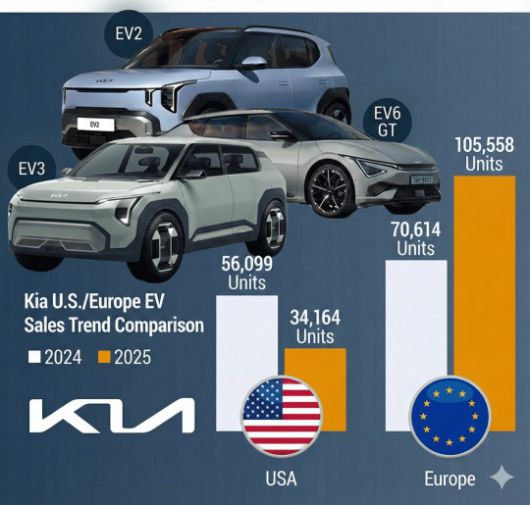
Looking solely at overall sales figures, Kia showed very solid growth last year. However, there's one catch. In the U.S., the world's largest EV market, Kia sold 34,164 electric vehicles last year, plunging approximately 38.8% compared to the previous year. The EV market chasm and subsidy reductions in the U.S. appear to have had an impact. Meanwhile, Hyundai Motor sold 69,533 EVs in the U.S. during the same period, setting a new record.
The impact of Kia's poor U.S. EV sales is significant. Combined Hyundai Motor and Kia EV sales in the U.S. totaled 103,697 units, a sharp decrease of approximately 16.3% year-over-year.
Kia's Real EV Stronghold is Europe... Surpassing 100,000 Units for First Time Last Year
It's not that Kia lacks competitiveness in the EV market. While U.S. market sales declined, the company achieved good results in Europe, another key market.
Last year, Kia sold 105,558 electric vehicles in Europe, surpassing 100,000 units for the first time. This significantly exceeds the previous year's 70,614 units and is approximately three times larger than its U.S. market performance.
Kia's European strength is also evident in its lineup differences. Last year in the European market, Kia completed its full segment of dedicated electric vehicles from EV3 to EV9, including launching the EV4. Additionally, it expanded into commercial EVs by introducing 'PV5,' Hyundai Motor Group's first PBV (Purpose Built Vehicle).
In contrast, Kia sells only two EV models in the U.S.: the EV6 and EV9. Since the EV9's U.S. launch in 2024, no additional new electric vehicles have been introduced to the American market. What drove Kia's sales growth in the U.S. were hybrid SUVs like the Sorento and Sportage.
North America for Hyundai, Europe for Kia... Clear Division of Roles
These differences in EV sales performance appear to stem from a division of roles between Hyundai Motor and Kia.
The strategy is for Hyundai Motor to focus on the North American market while Kia pursues growth centered on Europe.
This strategy becomes immediately clear when examining the career backgrounds of both companies' top executives and vehicle design philosophies. Hyundai Motor's president and CEO José Muñoz joined in April 2019 as Global COO and President & CEO of Hyundai Motor North America and Latin America. Both titles were key positions newly created or reorganized by Hyundai Motor to recruit José Muñoz.
Kia President and CEO Song Ho-sung is a European expert with a background in French literature. After joining Hyundai Motor in 1988, he moved to Kia in 2007. His first position at Kia was as head of the French subsidiary. He later served as head of the European operations, leading Kia's European sales expansion.
Design philosophies have also evolved to match each company's target markets. Hyundai Motor features a solid, bold impression with straight lines preferred by American consumers. Meanwhile, Kia has emphasized a sporty design identity seen in European premium brands.
The individuals who shaped each company's design also differ. For Hyundai Motor, it's Executive Vice President Lee Sang-yup, formerly of GM in the U.S. While he also worked at European brands including Volkswagen Group of America, he spent most of his career at GM and participated in designing the GM 'Chevrolet Camaro.'
For Kia, it's President Peter Schreyer, who served as chief designer at Porsche after working at Audi and Volkswagen. Peter Schreyer was responsible for the 'K Series' design represented by the 'Tiger Face' and the design of Kia's sports sedan 'Stinger.'
Kia to Concentrate on Europe Again This Year... Targeting U.S. with HEVs
Kia's EV strategy for this year is also concentrated on Europe. This year, Kia plans to focus on expanding local sales in Europe with the compact EV 'EV2' and the EV4 launched last year.
The EV2, unveiled for the first time globally by Kia at the '2026 Brussels Motor Show' on the 9th (local time), is Kia's sixth dedicated electric vehicle. It's evaluated as a strategic model targeting the European market with high demand for compact cars.
President Song Ho-sung stated, "The EV2 is the most compact among Kia's dedicated electric vehicles while offering a vibrant interior experience and emotional design," adding, "With its spacious interior and differentiated user experience, it will lead the popularization of electric vehicles."
At the Brussels Motor Show, Kia unveiled the EV3 GT, EV4 5-door GT, and EV5 GT, and displayed a total of 19 vehicles including various electrified models such as the EV3, EV4, EV5, EV9, and PV5, drawing interest from European consumers.
Additionally, Kia plans to respond to growing European demand by tripling the EV production capacity of its Slovakia plant by 2027 compared to current levels.
In the U.S. market, it seeks to expand sales centered on popular models such as the Telluride and Seltos. The Telluride in particular will debut its full-change model approximately six years after the first generation launched in 2019.
The new Telluride, going on sale starting in the first quarter of this year, has significantly enhanced its product appeal with best-in-class space utilization, advanced convenience and safety features, and an improved hybrid system offering better powertrain performance and fuel efficiency.
Notably, the hybrid powertrain with high demand in North America delivers maximum output of 329 horsepower and maximum torque of approximately 46.9 kgf·m. Compared to the existing gasoline 3.8 GDI engine, it reduces displacement by over 30% while increasing maximum output and maximum torque by approximately 13% and 29%, respectively.
Kim JaeHun (rlqm93@fntimes.com)
데일리 금융경제뉴스 FNTIMES - 저작권법에 의거 상업적 목적의 무단 전재, 복사, 배포 금지
Copyright ⓒ 한국금융신문 & FNTIMES.com
 이 기사의 카테고리는 언론사의 분류를 따릅니다.