 |
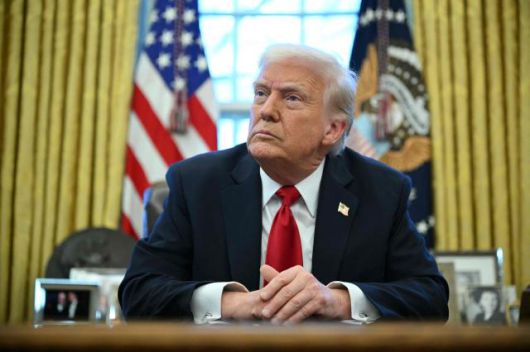
U.S. President Donald Trump announces tariffs on auto imports in the Oval Office of the White House in Washington, D.C. on March 26, 2025. AFP-Yonhap |
An administration official said on Friday that the U.S. would pursue "separate agreements for separate countries" when asked whether the semiconductor tariff waiver terms offered to Taiwan would also be granted to South Korea.
This suggests that Washington intends to define specific tariff and exemption conditions bilaterally with each major chip‑exporting partner, rather than adopting a single unified standard.
President Donald Trump has argued that semiconductor imports have reached a level that threatens U.S. national security and has instructed his administration to negotiate with relevant countries to address this perceived risk through tariffs.
Under this approach, Washington plans to negotiate first with countries that export semiconductors to the U.S. and only then impose tariffs, while offering "tariff offset programs" to companies that invest in strengthening the U.S. semiconductor supply chain.
Within this framework, the U.S. announced a trade agreement with Taiwan on Thursday that sets out the tariff waiver rules for Taiwanese semiconductor exports. In return for a commitment by Taiwanese firms to undertake $250 billion of direct investment in the U.S., Washington agreed to cut the reciprocal tariff rate on Taiwanese products from 20 percent to 15 percent, aligning it with the rate applied to South Korea and Japan.
Previously, South Korea had agreed to $350 billion in U.S. investment and Japan to $550 billion, in exchange for reductions in their respective reciprocal tariffs.
The Trump administration also decided that Taiwanese companies establishing new semiconductor production capacity in the U.S. will receive substantial tariff relief. While a new facility is under construction, imports of up to 2.5 times its production capacity can enter the U.S. market without paying the new semiconductor tariffs. After the facility is completed, imports of up to 1.5 times the new capacity can continue to enter tariff‑free.
South Korea finalized its trade negotiations with the U.S. at the end of October last year, ahead of Taiwan, and secured assurances that it would not be placed at a disadvantage compared with countries whose semiconductor trade volumes with the U.S. exceed South Korea's.
This implies that South Korea is expected to receive conditions at least equivalent to those applied to Taiwan, one of its key competitors, although how this principle will be implemented remains uncertain and is expected to be clarified through further negotiations with Washington.
Kim Hee-su Reporter khs@ajupress.com
- Copyright ⓒ [아주경제 ajunews.com] 무단전재 배포금지 -
 이 기사의 카테고리는 언론사의 분류를 따릅니다.