 |
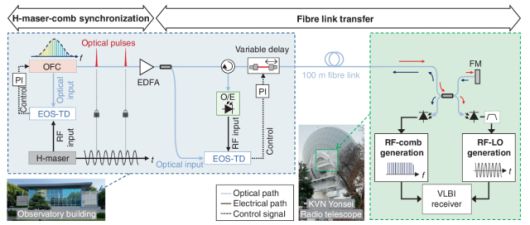
This schematic diagram illustrates the process of transmitting precise optical frequency comb signals from the observatory building to the KVN Yonsei Radio Telescope receiver to ensure accurate phase calibration. Courtesy of KAIST |
SEOUL, January 16 (AJP) - A joint research team led by the Korea Advanced Institute of Science and Technology (KAIST) has developed a technology to significantly improve the resolution of radio telescopes using laser optics. By applying an "optical frequency comb" directly to telescope receivers, the researchers aim to capture sharper images of black holes and enhance precision in deep space exploration.
KAIST announced on January 15 that the team, led by Professor Kim Jung-won of the Department of Mechanical Engineering, successfully implemented the technology in collaboration with the Korea Astronomy and Space Science Institute (KASI), the Korea Research Institute of Standards and Science (KRISS), and the Max Planck Institute for Radio Astronomy (MPIfR) in Germany.
Radio telescopes are designed to capture faint radio signals from space and convert them into images of celestial bodies. To observe distant objects like black holes with high clarity, astronomers use a technique called Very Long Baseline Interferometry (VLBI). This method connects multiple radio telescopes located far apart so they function as a single, massive telescope.
For VLBI to work effectively, the signals captured by each telescope must be synchronized with extreme precision. The telescopes must align the "phase" of the received waves as if they were measured against a single, precise ruler.
However, conventional electronic reference signals used for this synchronization face limitations. As observation frequencies increase, the electronic reference signals become unstable, introducing noise or "jitter" that makes precise phase calibration difficult.
The research team solved this problem by introducing an optical frequency comb—a laser source that acts as a "ruler made of light." Unlike a standard laser that emits a single color (frequency), an optical frequency comb emits hundreds of thousands of precise frequency modes spaced at exact intervals, resembling the teeth of a comb.
The team developed a method to transmit this laser light directly into the radio telescope's receiver. This creates a reference signal that is far more stable than traditional electronic methods.
"If the existing method was like using a ruler with trembling markings, this new technology is comparable to establishing a standard using a ruler of light that is extremely stable," the researchers explained. This allows distant telescopes to be linked with much higher precision.
The technology was validated through test observations at the Korean VLBI Network (KVN) Yonsei Radio Telescope. The team successfully detected stable interference patterns, known as fringes, between telescope signals, proving that precise phase calibration is possible using the optical system. The system has also been installed at the KVN Seoul National University Pyeongchang Radio Telescope for expanded experiments involving multiple observatories.
Professor Kim Jung-won said, "This study overcomes the limitations of existing electronic signal generation technology by directly applying the optical frequency comb laser to radio telescopes. It will contribute to increasing the precision of next-generation black hole observations and advancing the fields of frequency metrology and time standards."
Beyond astronomy, the researchers anticipate the technology will be applied to other fields requiring precise time and space measurements, such as intercontinental atomic clock comparisons, space geodesy, and the tracking of deep space probes.
The research was supported by the National Research Council of Science and Technology (NST), the National Research Foundation of Korea (NRF), and the Institute for Information and Communications Technology Planning and Evaluation (IITP).
(Paper information)
Journal: Light: Science & Applications (Impact Factor 23.4) Title: Optical frequency comb integration in radio telescopes: advancing signal generation and phase calibration
DOI: http://bit.ly/4qYCFi5
Park Sae-jin Reporter swatchsjp@ajunews.com
- Copyright ⓒ [아주경제 ajunews.com] 무단전재 배포금지 -
 이 기사의 카테고리는 언론사의 분류를 따릅니다.