 |
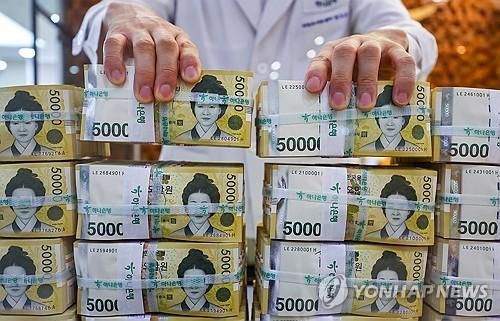
This undated photo shows an employee organizing stacks of 50,000-won banknotes at Hana Bank’s Anti-Counterfeiting Center in Seoul. Yonhap. |
SEOUL, January 14 (AJP) - South Korea’s broad money growth stalled in November under a revised definition of M2, reflecting both a statistical adjustment and a deeper shift in investor behavior toward short-term, high-return assets.
According to data released Wednesday by the Bank of Korea (BOK), the M2 money supply stood at 4,057.5 trillion won ($2.77 trillion) in November 2025, little changed from the previous month and marking a second consecutive month of flat growth. The figure represents a slight decline from October’s 4,059.5 trillion won.
Beginning in January, the BOK revised its M2 methodology in line with International Monetary Fund (IMF) standards, excluding beneficiary certificates — including exchange-traded fund (ETF) units — from the broad money total due to their high price volatility. Under the previous definition, November M2 would have amounted to 4,498.6 trillion won, showing a modest month-on-month increase.
Even after accounting for the revision, the data point to heightened liquidity volatility, driven by investor preference for fast-turnover assets such as equities and short-term bonds.
On a year-on-year basis, M2 rose 4.8 percent in November, slowing from October’s 5.2 percent increase. While moderating, Korea’s monetary expansion continues to outpace that of major reserve-currency economies, exceeding the United States’ 4.3 percent growth and Japan’s 1.8 percent.
Liquidity levels also remain elevated relative to economic output. Data submitted by the BOK to Rep. Park Sung-hoon of the ruling People Power Party show Korea’s M2-to-GDP ratio at 153.8 percent — more than double the 71.4 percent recorded in the United States.
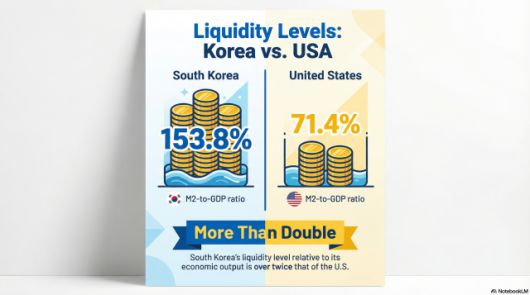 |
Generated with Notebook LM. |
The composition of money holdings highlights a growing bias toward liquidity. Financial bonds with maturities of less than two years increased by 4.2 trillion won, while marketable instruments rose by 2.5 trillion won, reflecting a shift away from longer-term financial products amid a buoyant securities market and rising demand for overseas equities.
The trend has carried into the new year. Recent data released Tuesday show demand deposits at the country’s five major banks fell by about 27 trillion won from end-December levels, while investor deposits climbed to a record high exceeding 90 trillion won as of Jan. 8 — signaling an accelerating flow of funds from bank accounts into equity markets.
By sector, corporations increased their M2 holdings by 11 trillion won in November, while “other financial institutions,” including brokerages and asset managers, added 8.7 trillion won. In contrast, money holdings by households and non-profit organizations declined by 12.3 trillion won, underscoring the rapid shift by individual investors toward riskier assets.
Kim Yeon-jae Reporter duswogmlwo77@ajupress.com
- Copyright ⓒ [아주경제 ajunews.com] 무단전재 배포금지 -
 이 기사의 카테고리는 언론사의 분류를 따릅니다.


![황신혜 "남동생 목 다쳐 전신마비..29살에 사고 당해" [핫피플]](/_next/image?url=https%3A%2F%2Fthumb.zumst.com%2F256x144%2Fhttps%3A%2F%2Fstatic.news.zumst.com%2Fimages%2F29%2F2026%2F01%2F15%2F8cdc396aa1f64879a607d0eff080877f.png&w=384&q=100)