 |
Graphics by Song Ji-yoon |
SEOUL, January 12 (AJP) - The long-awaited merger between Korean Air and Asiana Airlines is finally approaching completion. But for millions of Asiana passengers, one question matters more than regulatory approvals or aircraft numbers: What happens to my miles, status and benefits?
As Asiana is absorbed into Korea's larger flag carrier, its brand, loyalty program and global alliance will all disappear. While the combined airline promises greater scale and efficiency, many frequent flyers fear they may lose hard-earned advantages along the way.
 |
Graphics by Song Ji-yoon |
The most sensitive issue remains mileage integration, now widely seen as the final hurdle to full merger approval.
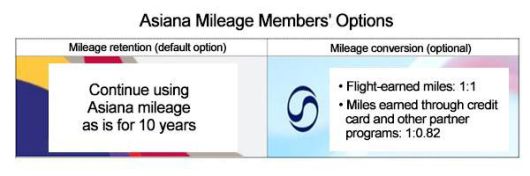
In September last year, Korean Air proposed converting flight-earned miles at a 1:1 ratio, while credit-card miles would be converted at 1:0.82. Consumer groups objected immediately, arguing that the two airlines' mileage programs are not equal in value.
Industry estimates put the value of a Korean Air mile at about 21–23 won ($0.02), compared with 17–19 won for an Asiana mile. The gap reflects stricter qualification rules at Korean Air, where elite status requires far more flying.
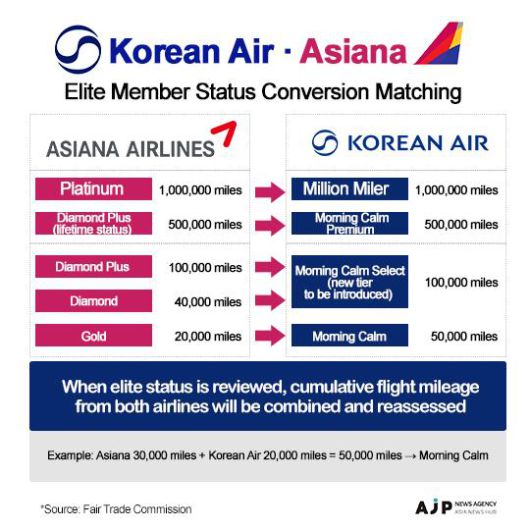
Asiana flyers currently reach Gold status at 20,000 miles, while Korean Air's entry-level elite tier, Morning Calm, requires 50,000 miles. That difference has allowed many travelers to earn a higher status more easily on Asiana.
 |
Graphics by Song Ji-yoon |
Under the merger, the two loyalty systems will eventually be combined. That raises fears on both sides: Asiana customers worry their miles and status will be downgraded, while Korean Air elites fear their hard-earned privileges will be diluted if the elite pool suddenly expands.
One frequent flyer summed it up online:
"If lounge access and upgrades don't expand with the number of elite members, benefits will lose their meaning."
To address criticism, Korean Air revised its plan, proposing to keep the two mileage programs separate for 10 years, with no conversion during that period. After a decade, all miles would move under Korean Air's Skypass program.
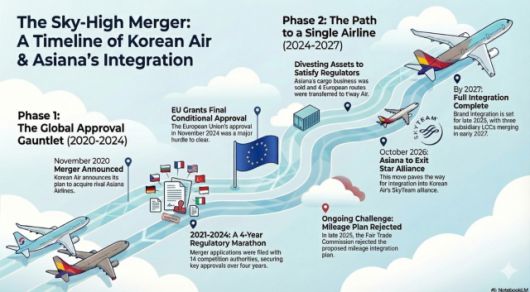
The Fair Trade Commission (FTC) rejected that proposal in December, asking for stronger guarantees on award-seat availability and mileage upgrades — a decision that has pushed final integration further into the future.
Alliance change: fewer global perks
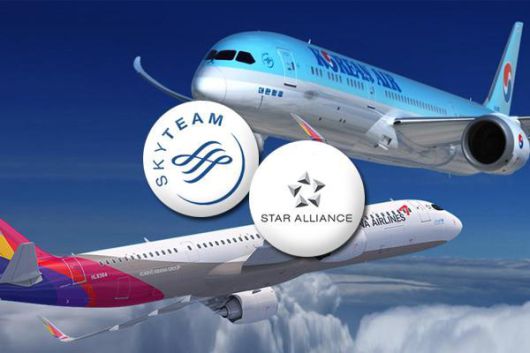
Another major change is Asiana's exit from Star Alliance in October. The airline will move to SkyTeam, Korean Air's alliance, because airlines cannot belong to two alliances at once.
For many Asiana frequent flyers, this is a clear loss. Star Alliance has 25 member airlines, compared with SkyTeam's 19, and offers broader global coverage and lounge access.
Korean Air says SkyTeam is sufficient for major routes and that customers will gain better access to its direct flights. Business travelers, however, say the shift reduces flexibility rather than improving it.
One brand survives — and it's not Asiana
The merger also ends Asiana Airlines as a standalone brand.
Korean Air has made clear it will operate the combined carrier under its own name. Last year, it unveiled a refreshed logo and aircraft design, replacing "KOREAN AIR" with a simplified "KOREAN."
For Asiana customers, the message is clear: this is not a merger of equals.
The physical transition will also take time. Korean Air must repaint 238 aircraft, including 68 from Asiana, by 2027. Each repaint can take up to 15 days and cost nearly 1 billion won, raising questions about cost and disruption during the transition.
 |
Graphics generated by NotebookLM and Gemini |
Legally, the deal is almost done. Korean Air completed the acquisition on Dec. 11, 2024, after securing approvals in 14 jurisdictions.
Once fully integrated, the airline will rank among the world's top ten, with more than 230 aircraft, service to 120 cities and annual revenue exceeding 23 trillion won. At Incheon Airport, it will control about 37 percent of slots, with Asiana moving to Terminal 2 in mid-January 2026 for smoother transfers.
Yet analysts say scale alone won't determine success.
"If customers feel their loyalty was simply erased, the merger's long-term value will suffer," one industry official said.
The question is no longer whether the merger will happen —
but whether Korean Air can keep the trust of Asiana’s passengers once it does.
Kim Hee-su Reporter khs@ajupress.com
- Copyright ⓒ [아주경제 ajunews.com] 무단전재 배포금지 -
 이 기사의 카테고리는 언론사의 분류를 따릅니다.