 |
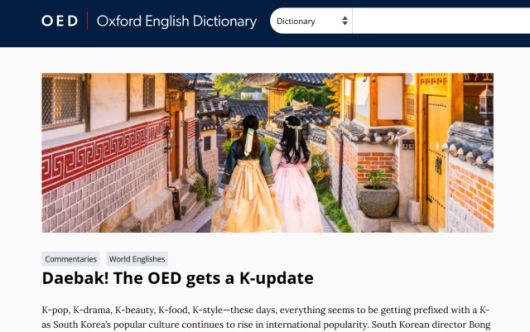
Screenshot from OED webpage |
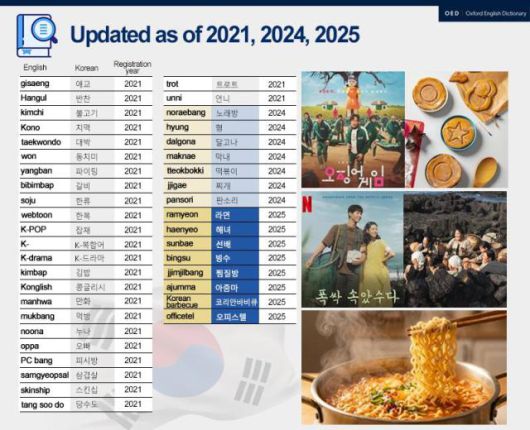
SEOUL, January 07 (AJP) -As Korean dramas, music and food continue to spread across global streaming platforms and dining tables, the Oxford English Dictionary (OED) has added eight new Korean-origin words to its latest update, underscoring how Korean culture is becoming part of everyday English usage.
The newly added entries include ramyeon, haenyeo and sunbae, along with bingsu, jjimjilbang, ajumma, Korean barbecue and officetel. The additions follow last year’s inclusion of seven Korean words such as dalgona, maknae and tteokbokki, marking the second consecutive year that Korean-related terms have expanded in the dictionary.
First published in 1884, the OED is regarded as the most authoritative historical record of the English language. Now operated as a continuously updated online platform, it adds new entries only after sustained and verifiable usage in English-language sources. Once included, words are not removed, even if their frequency later declines.
The dictionary said the latest additions reflect the growing presence of Korean culture in English-speaking societies, driven largely by the global popularity of Korean television series, films, music and cuisine.
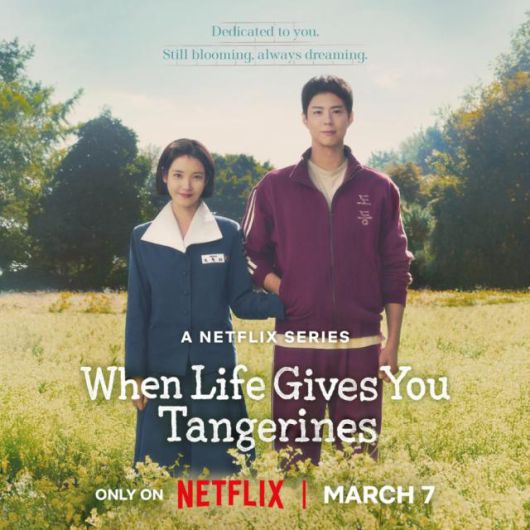 |
When Life Gives You Tangerines poster (Courtesy of Netflix) |
The inclusion of haenyeo this year reflects heightened global awareness of Korea’s traditional female divers, fueled in part by the international success of the Netflix drama "When Life Gives You Tangerines", which portrays life in mid-20th-century Jeju and prominently features the island’s haenyeo culture.
The series has drawn attention not only to Jeju’s landscape but also to the lives and labor of its women divers, bringing the term into wider English-language discussion.
A similar pattern was seen last year with dalgona, which entered the OED following the global phenomenon of "Squid Game". The series propelled the traditional sugar candy into worldwide recognition, with the term appearing frequently in English-language media, recipes and social platforms.
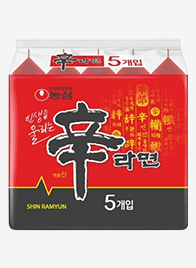
Food-related terms continue to feature prominently. Ramyeon is one such example. While the Japanese term ramen was added earlier, the Korean spelling and usage have gained distinct recognition as Korean food and media reached wider international audiences. In recent years, ramyeon has appeared repeatedly in global streaming hits, where it often functions as a shared ritual rather than simply a meal.
Social and relational terms were also highlighted. The addition of sunbae reflects growing familiarity with Korean expressions describing hierarchical relationships. Unlike the English word “senior,” sunbae conveys a broader mix of hierarchy, familiarity and responsibility shaped by Korean social norms. Other relational terms, including oppa and maknae, were added in previous updates.
Lifestyle-related words such as jjimjilbang and bingsu were included as references to uniquely Korean experiences that are difficult to translate into existing English terms. Their usage has increased as Korean lifestyle content has circulated widely through streaming platforms, social media and travel-related media.
The OED also formally added Korean barbecue as an English expression, expanding beyond individual dish names such as galbi, samgyeopsal and bulgogi, which were already listed. The dictionary cited usage dating back to a 1938 Hawaiian newspaper as part of its historical record.
According to Jieun Kiaer, a professor of Korean linguistics at the University of Oxford who serves as a consultant to the dictionary, inclusion in the OED requires clear textual evidence that a word is being regularly used and discussed in English-speaking contexts. She noted that once a word enters the dictionary, it remains permanently as part of the historical record.
The steady expansion of Korean-origin words in the OED reflects how Korean content and cuisine have moved beyond niche interest to become embedded in everyday language, signaling a lasting linguistic imprint of Korean culture on global English usage.
 |
Graphics by Song Ji-yoon |
Seo Hye Seung 편집국장 ellenshs@ajunews.com
- Copyright ⓒ [아주경제 ajunews.com] 무단전재 배포금지 -
 이 기사의 카테고리는 언론사의 분류를 따릅니다.


![지상렬, ‘♥16살 연하’ 신보람과 결혼한다 “母와 상견례…명품 선물까지”[Oh!쎈 이슈]](/_next/image?url=https%3A%2F%2Fthumb.zumst.com%2F256x144%2Fhttps%3A%2F%2Fstatic.news.zumst.com%2Fimages%2F29%2F2026%2F01%2F18%2F873cf103f75f42a88b0c61886275841d.jpg&w=384&q=100)