
 |
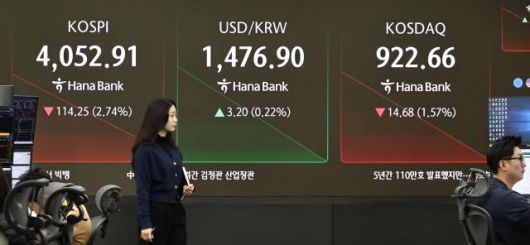
A view of Hana Bank dealing room in Seoul. Yonhap. |
SEOUL, December 15 (AJP) - The Korean won hovering near its weakest level on record is set to ripple across the economy, from higher inflation and capital outflows to a deepening discount on Korean assets and companies.
The dollar closed Monday in Seoul at 1,472.2 won, down 5.30 won, as the yen strengthened broadly on expectations of a rate hike in Japan later this week. The modest pullback offered only fleeting relief for policymakers.
Authorities were alarmed enough to convene an emergency meeting on Sunday, attended by the finance minister, central bank governor, financial regulators and senior officials from the presidential office, welfare ministry and industry ministry, after the dollar approached 1,480 won in over-the-counter trading.
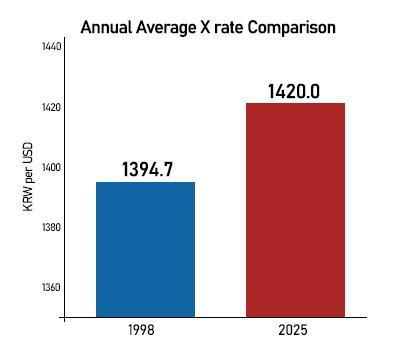
Despite the brief rebound, the won’s slide has reached historic proportions. The average dollar-won exchange rate for the year through Dec. 14, 2025, stands at 1,420 won — surpassing the previous record of 1,394.7 set in 1998, when South Korea was under an International Monetary Fund bailout.
 |
Graphics by AJP Song Ji-yoon |
The longer-term trend is equally troubling. The won has weakened steadily since 2021, initially reflecting ultra-loose global liquidity during the pandemic, followed by aggressive post-pandemic monetary tightening.
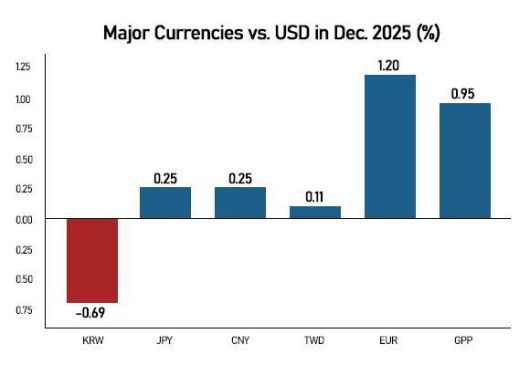
What stands out now is a clear decoupling. The won is falling sharply against the backdrop of dollar softening and rate cuts in the U.S. So far this month, the won has lost 0.7 percent against the dollar, while most major currencies have gained.
 |
Graphics by AJP Song Ji-yoon |
Economists increasingly point to excess liquidity as the root cause. Korea’s policy normalization has proceeded more slowly and cautiously than elsewhere, largely out of concern over household debt levels, among the highest in the world.
“If I had to summarize the reason for the exchange rate rise in one word, it would be ‘liquidity,’” said Kim Gwang-seok, director of economic research at the Korea Institute for Industrial Economics & Trade.
Korea’s broad money supply (M2) grew 8.5 percent year over the year as of September, according to the Bank of Korea. Even excluding exchange-traded funds, growth stood at 6.3 percent — up to three times faster than the United States’ 4.6 percent and Japan’s 1.8 percent.
An oversupply of won inevitably erodes its value.
“When M2 expands, inflation rises, household debt swells, and exchange-rate instability accelerates as the supply of won increases,” said Moon Hong-cheol, an analyst at DB Securities.
The liquidity glut has spilled across borders. Korean nationals’ overseas equity purchases surged to $18 billion in October — six times the $2.93 billion foreign investors put into Korean stocks — according to Bank of Korea data.
Flush with cash, Koreans are choosing foreign assets over domestic ones, a telling verdict on confidence in the won.
Large-scale capital commitments abroad are also adding pressure. The $350 billion in promised investments in the United States, agreed during bilateral trade negotiations, are widely cited as another structural source of net won outflows.
Unlike Japan, which benefits from a standing currency swap line with the U.S., South Korea has limited buffers, relying on foreign-currency bond issuance or returns from overseas assets — constraints that weigh on its dollar liquidity.
A weak won quickly feeds into prices. Import costs are rising even as global energy prices fall.
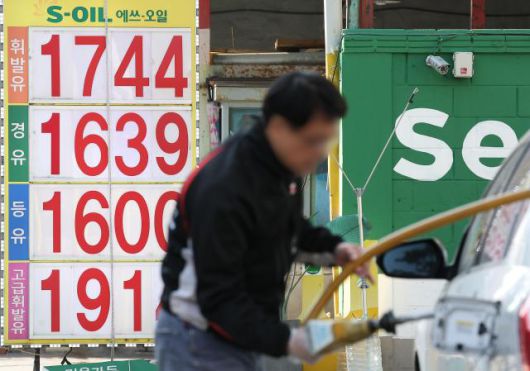 |
Gasoline prices are displayed at a gas station in Seoul on December 2. Yonhap. |
South Korea’s import price index rose 2.6 percent on month and 2.2 percent on year in November, the steepest monthly increase since April last year. This came despite Dubai crude averaging $64.47 per barrel, down from $65 in October, underscoring how exchange rates — not commodity prices — are driving inflationary pressure.
Beyond households, prolonged currency weakness threatens longer-term damage to Korean Inc.
Cross-border mergers and acquisitions reached nearly $3 billion as of September, up 54 percent on year, accounting for 13 percent of the $20.65 billion in foreign direct investment pledged by the third quarter, according to the Ministry of Trade, Industry and Energy. FDI inflows jumped 36.5 percent to $3.07 billion as a won that averaged 4 percent weaker than last year’s level effectively discounted Korean assets.
High-profile targets such as Lotte Rental and IGIS Asset Management have drawn aggressive foreign interest — a grim reminder of past episodes when distressed Korean companies were snapped up during IMF crisis in what felt like fire sales.
Underlying growth also weighs over the currency prospects.
“Semiconductor exports have increased, but the domestic economy has failed to emerge from its slump, and shrinking domestic investment is entrenching a low-growth trajectory,” the Korea International Trade Association said in a report last week, calling for structural reform.
“Attempts to manage currency supply and demand without addressing fundamental structural issues will ultimately fall short,” the report warned.
Kim Yeon-jae Reporter duswogmlwo77@ajupress.com
- Copyright ⓒ [아주경제 ajunews.com] 무단전재 배포금지 -
 이 기사의 카테고리는 언론사의 분류를 따릅니다.


!["고맙다"...'제자와 부적절 관계' 들통난 교사가 남편에 한 말 [그해 오늘]](/_next/image?url=https%3A%2F%2Fthumb.zumst.com%2F256x144%2Fhttps%3A%2F%2Fstatic.news.zumst.com%2Fimages%2F24%2F2025%2F12%2F15%2Ff434cd7aff6047079b777ecaca14601e.jpg&w=384&q=100)