 0
0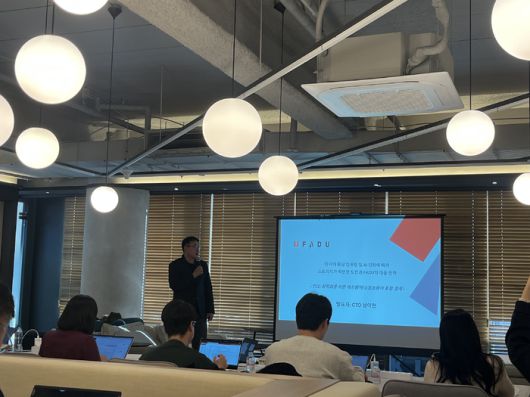 |
(Ahn Seo-jin) |
South Korean controller manufacturer Fadu Inc. underscored the growing importance of architecture optimization for efficiency and performance as solid state drive (SSD) demand continues to rise.
At the Tech Press Day 2025 event held Thursday, Chief Executive Officer Nam Eyee-hyun outlined the challenges facing storage in an era shaped by data-centric computing and rapid advances in artificial intelligence (AI).
As AI clusters scale and multimodal model training accelerates, demand for storage is expected to reach the exabyte level. One exabyte is roughly 1 billion times larger than 1 gigabyte.
 |
(Yonhap) |
Nam said the industry can no longer rely on shrinking semiconductor nodes or incremental processor gains under Moore’s Law.
“The focus has shifted to architectural innovation and total cost of ownership optimization,” he said.
With graphic processing units and artificial intelligence accelerators becoming central to data-center operations, Nam said storage systems must now deliver both high performance and strong power efficiency.
Fadu develops its own Non-Volatile Memory Express (NVMe) SSD controllers, which are built as Application-Specific Integrated Circuits (ASICs), along with in-house firmware. The company relies on hardware-specific optimization rather than general-purpose processors to balance performance and power efficiency.
The design minimizes power use at the controller level so more power can be allocated to NAND flash memory, enabling high performance without sacrificing architectural flexibility. Fadu also enhanced NAND reliability and secured compatibility across multiple NAND suppliers.
The company said it has demonstrated advantages over rivals in performance, power efficiency, and feature sets, with millions of controllers shipped across its Gen3 through Gen5 product lines.
For its upcoming Gen7 platform, Fadu is targeting 100 million Input/Output Per Second in 512-byte random reads. Reaching that level requires tapping the full transfer bandwidth of Peripheral Component Interconnect Express, processing single I/O operations in 10 nanoseconds, and allowing DRAM to handle access to 100 million metadata units each second.
“Integrated optimization across SSDs and power management semiconductors will become a key driver of system performance and cost efficiency in the AI era,” Nam said.
He added that Fadu plans to explore next-generation power-chip markets as demand grows for new semiconductor technologies tailored to future data-center architectures.
As power efficiency becomes more important across data centers, power semiconductors are emerging as the most cost-effective tool for reducing energy consumption in information-technology infrastructure.
The power-management integrated circuit market for data-center components is projected to grow at an annual average of 19 percent from 2.1 trillion won ($1.4 billion) in 2023 to around 10 trillion won in 2032.
 이 기사의 카테고리는 언론사의 분류를 따릅니다.