 0
0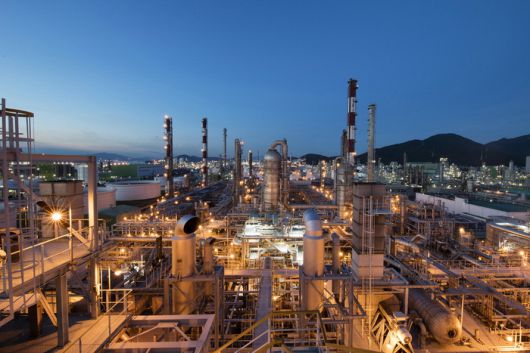 |
(Lotte Chemical) |
South Korea’s petrochemical industry has taken its first major step toward large-scale restructuring as profits worsen due to China’s supply glut.
Lotte Chemical Corp. and HD Hyundai Chemical Co. announced on Wednesday that they have jointly submitted a request to the Ministry of Trade, Industry and Energy for a preliminary government review of their petrochemical business restructuring plan.
This is the first restructuring proposal filed since the government and industry began formal discussions in August.
The companies are seeking the industry‘s first facility consolidation in response to the persisting global oversupply in the general-purpose petrochemical segment centered on naphtha cracking centers (NCCs).
The core of the restructuring involves carving out Lotte Chemical’s plant in the Daesan Petrochemical Complex in South Chungcheong Province through a physical split and then merging it with HD Hyundai Chemical to integrate NCC operations.
Under the proposal, Lotte Chemical will physically spin off its Daesan NCC plant to create a new entity, which will then be merged into HD Hyundai Chemical.
In the merger, HD Hyundai Chemical will remain as the surviving entity, while the newly spun-off company will be dissolved.
Lotte Chemical will then acquire additional shares in the merged entity.
Ultimately, HD Hyundai Oilbank Co. and Lotte Chemical will each hold a 50 percent stake in the merged entity, effectively creating a single jointly operated NCC entity for the Daesan complex.
NCC profitability in the petrochemical industry has fallen sharply in recent years.
China has aggressively expanded production capacity for ethylene, propylene, and other basic petrochemicals, deepening the global supply glut.
Korean companies have long recognized the risk that maintaining a business structure centered on low-margin commodity products undermines competitiveness. With voluntary restructuring not taking place, however, the government stepped in to provide clear targets and direction.
In August, the government urged an industrial complex-level restructuring that required companies to voluntarily reduce 2.7 million to 3.7 million tons of NCC capacity, which corresponds to 18 percent to 25 percent of Korea’s total capacity of 14.7 million tons.
The government expects this restructuring attempt to serve as a catalyst for broader sector-wide consolidation.
It views global competition in general-purpose petrochemicals centered on NCCs as so intense that individual firms cannot secure competitiveness through their isolated investments or incremental efficiency improvements.
Industry observers expect that once this first restructuring case is approved, similar discussions will accelerate at other NCC bases, such as in Yeosu and Ulsan.
The planned consolidation is subject to a pre-review by the Fair Trade Commission (FTC).
This system allows companies preparing for a business combination to request the FTC to pre-examine whether their combination restricts competition prior to formal filing.
The FTC plans to concentrate its administrative capacity on reviewing the petrochemical companies‘ business restructuring plans over the next few months.
However, for timely reviews, observers noted that companies must actively use the pre-consultation and preliminary assessment systems and promptly submit the necessary materials.
Still, there is pushback from within the petrochemical industry.
Some argue that if China’s oversupply is the root cause, the solution should not simply be capacity cuts but rather facilitating a shift toward advanced, higher-value industries.
“Restructuring should not simply force sacrifice from companies; discussions must also include support for transitioning into specialized, high value-added industries,” said an official from the petrochemical industry.
“Given the capital-intensive nature of the petrochemical industry, companies invest in massive facilities with the expectation of operating them for more than 20 years, so abandoning them is not an easy choice,” noted another industry insider. “Even if domestic ethylene output decreases, if Chinese petrochemical products remain price-competitive, we cannot rule out the possibility that our petrochemical sector will be encroached upon by China.”
 이 기사의 카테고리는 언론사의 분류를 따릅니다.


![친근한 이미지였는데…조세호 조폭 연루설→박나래 갑질·폭언 논란 충격 "타격 불가피" [엑's 이슈]](/_next/image?url=https%3A%2F%2Fthumb.zumst.com%2F256x144%2Fhttps%3A%2F%2Fstatic.news.zumst.com%2Fimages%2F108%2F2025%2F12%2F05%2F411defae84b14f298ccd2d352dc5ad2e.jpg&w=384&q=100)