 |
(KARI) |
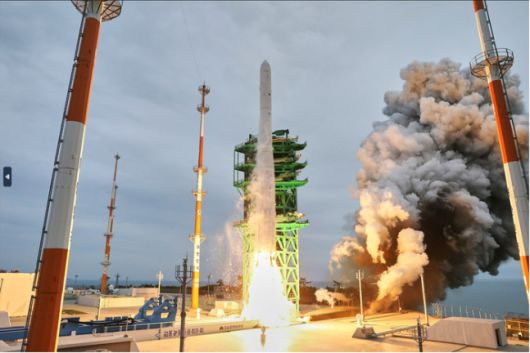
As Korea prepares for the fourth launch of the Nuri rocket, Samsung Electronics and LG Electronics are emerging as key players in space technology, ranking ahead of the Korea Aerospace Research Institute (KARI) in intellectual property (IP) competitiveness.
According to a joint report by Maeil Business Newspaper and global patent analytics firm LexisNexis released Sunday, Samsung and LG have established strong quantitative and qualitative IP portfolios, positioning themselves for leadership in the “New Space” era, driven by private-sector innovation.
The report analyzed domestic organizations by their Patent Asset Index (PAI) and patent volume. PAI reflects the number of patents held, their technological influence, and market impact. Samsung ranked first in PAI, followed by LG. Samsung’s portfolio focuses on data transmission and wireless technologies—including payload control, satellite power and signal processing, navigation, detection, and collision avoidance—core to developing 5G and 6G satellite-ground integrated communication networks.
LG’s patents similarly center on AI-optimized, low-power intelligent wireless network technologies connecting satellites and terrestrial systems.
“Samsung leads in software and protocol platforms for integrated satellite-ground networks, while LG excels in intelligent hardware, sensor systems, and energy innovation, forming a complementary structure in Korea’s space communications industry,” said Kim Dong-hyun, senior consultant at LexisNexis Intellectual Property Solutions
Following Samsung and LG were KARI, the Electronics and Telecommunications Research Institute (ETRI), Hyundai Motor, KT, Korea University, and the Agency for Defense Development (ADD). In patent quantity, KARI ranked first, followed by ADD, Samsung, ETRI, and Hanwha Systems.
Hanwha Aerospace did not make the top list due to its space-related patents being distributed among affiliates like Hanwha Systems.
Globally, space technology patents have grown 11 percent annually from 2010 to 2024, after decades of stagnation. Korea shows steady growth, reflecting consistent government support for satellite launches and lunar exploration.
KARI continues to lead in national space development, credited with multi-purpose satellites (Arirang), meteorological satellites (Cheollian), lunar orbiter Danuri, and the Nuri rocket. ADD follows closely with expertise in military communication and reconnaissance satellites, while ETRI leads in space data, communications, and network technologies such as 6G, quantum encryption, and AI-based satellite data processing.
Hanwha Group is driving commercialization and private-sector expansion of space technology, strengthening its value chain from satellite manufacturing to launch and data services through its 2021 acquisition of Satrec Initiative.
LexisNexis also highlighted other Korean leaders by field.
Perigee Aerospace, Samsung, Innospace, ADD, SPACEBEY, and CONTEC were identified as key players in launch vehicle systems, while KARI, Yonsei University, Seoul National University, Kyung Hee University, Chosun University, and LIG Nex1 led satellite development. In propulsion systems, KARI, ADD, Innospace, Hanwha, and Pusan National University ranked among the leading institutions.
“Expanding R&D in reusable rockets, methane engines, AI satellites, and space debris removal is essential,” Kim said, adding that Korea should “strengthen IP diplomacy by joining international projects with NASA and the European Space Agency (ESA).”
 이 기사의 카테고리는 언론사의 분류를 따릅니다.


![故이순재 유언 공개됐다…박근형 "마지막으로 본 건 1월, 연극계 맡아달라고" [엑's 이슈]](/_next/image?url=https%3A%2F%2Fthumb.zumst.com%2F256x144%2Fhttps%3A%2F%2Fstatic.news.zumst.com%2Fimages%2F108%2F2025%2F12%2F29%2F179d34f7c3a24180ac4b20c241ad44d8.jpg&w=384&q=100)
![“포옹하고 입맞춰”…유명 트로트 여가수, 상간 소송 피소 중에도 방송 출연 '충격' (사건반장)[종합]](/_next/image?url=https%3A%2F%2Fthumb.zumst.com%2F256x144%2Fhttps%3A%2F%2Fstatic.news.zumst.com%2Fimages%2F108%2F2025%2F12%2F29%2Fd268a48823d44c0db3a07b48827ab4f4.jpg&w=384&q=100)